Enhanced performance of Sr2Si5N8: Eu2+ red afterglow phosphor by co-doping with boron and oxygen

Journal of Luminescence 204 (2018) 36–40

Herein we report the improvement in persistent luminescence of Eu2+ doped Sr2Si5N8 nitride phosphor. A systematic experiment has been performed to investigate the influence of co-doping B3+, O2-, Tm3+ in Sr2Si5N8: Eu2+. It is found that B3+ and O2- co-doped Sr2Si5N8: Eu2+ phosphor exhibits better afterglow properties with higher afterglow intensity, which can be attributed to larger trap density. The afterglow luminescence mechanism in Sr2Si5N8: Eu2+, B3+, O2- is discussed on the basis of the host referred binding energy (HRBE) scheme of Sr2Si5N8, the relative energy level positions of 5d and 4 f electron of Eu2+ and the trap depth in the host lattice .

Next‐Generation Narrow‐Band Green‐Emitting RbLi(Li3SiO4)2:Eu2+ Phosphor for Backlight Display Application

Adv. Mater. 2018, 30, 1802489. https://doi.org/10.1002/adma.201802489

The discovery of high efficiency narrow-band green-emitting phosphors is a major challenge in backlighting light-emitting diodes (LEDs). Benefitting from highly condensed and rigid framework structure of UCr4C4-type compounds, a next-generation narrow green emitter, RbLi(Li3SiO4)2:Eu2+ (RLSO:Eu2+), has emerged in the oxide-based family with superior luminescence properties. RLSO:Eu2+ phosphor can be efficiently excited by GaN-based blue LEDs, and shows green emission at 530 nm with a narrow full width at half maximum of 42 nm, and very low thermal quenching (103%@150 °C of the integrated emission intensity at 20 °C), however its chemical stability needs to be improved later. The white LED backlight using optimized RLSO:8%Eu2+ phosphor demon-strates a high luminous efficacy of 97.28 lm W−1 and a wide color gamut (107% National Television System Committee standard (NTSC) in Commission Internationale de L’Eclairage (CIE) 1931 color space), suggesting its great poten-tial for industrial applications as liquid crystal display (LCD) backlighting .

5d-level centroid shift and coordination number of Ce3+ in nitride compounds

Journal of Luminescence 200 (2018) 35–42

Energy of 5d-levels of Ce3+ in numerous nitrides has become available due to the development of nitride phosphors recently. In this work, we have collected data on 5d-levels of Ce3+ and reconsidered the 5d centroid shift of Ce3+ in nitrides. The uniform standard, derived from the bond valence theory and the requirement for the high stability of the coordination polyhedron, has been proposed to determine the coordination number. The relationship between the 5d centroid shift of Ce3+, the polarizability of the anions and the electronegativity of the cations is revealed. The anion polarizability is linearly related to the inverse square of the average electronegativity of the cations; and the 5d centroid shift of Ce3+ can be well predicted by virtue of crystallographic data. This paper provides a feasibility to predict luminescence properties of Ce3+-doped nitrides .

Crystal field splitting of 4fn−15d-levels of Ce3+ and Eu2+ in nitride compounds

Journal of Luminescence 194 (2018) 461–466

Recently a lot of Ce3+/Eu2+-activated nitride and oxonitride phosphors have been explored due to potential or practical application for white-light LEDs. In this paper, data of crystal field splitting of the 4f n−15d-levels of Ce3+ and Eu2+ in nitride compounds is collected and analyzed. The relationship between the crystal field splitting and the coordination polyhedron around the Ce3+ and Eu2+ is revealed, showing that crystal field splitting is related to coordination number, polyhedron shape and size, while being irrelevant of the anion types. In addition, the crystal field splitting of Ce3+ and Eu2+ in the nitride compounds is correlated by a multiplication factor 0.76, which is in consistent with those in halides, sulfides and oxides. This paper makes it possible to predict luminescence properties of Ce3+- or Eu2+- doped nitride compounds .

Synthesis, structure and luminescence of SrLiAl3N4:Ce3+ phosphor

Journal of Luminescence 199 (2018) 271–277

Here we report a new phosphor, Ce-doped SrLiAl3N4, which can be effectively excited by green light at ~ 517 nm. A series of synthetic experiments are performed to find an optimal scheme. This phosphor has two emission bands at ~ 545 and ~ 610 nm corresponding to the d-f electronic transition of Ce3+. Large centroid shift of 5d level results in a green light-excitable feature. Compared to other Ce3+-doped nitrides, the crystal field splitting of 5d energy levels for this phosphor, i.e. about 11,300 cm−1, is much smaller due to larger volume and smaller distortion of coordination polyhedron of Ce3+. The phosphor shows an excellent luminescent thermal quenching behavior. At 150 °C, the emission intensity retains about 93% of the initial value at room temperature upon 517 nm excitation. This property can be ascribed to rigid structure and large gap between 5d levels and bottom of conduction band .

The Inductive Effect in Nitridosilicates and Oxysilicates and Its Effects on 5d Energy Levels of Ce3+

Inorg. Chem. 2018, 57, 4, 2320–2331. https://doi.org/10.1021/acs.inorgchem.7b03253

The inductive effect exists widely in inorganic compounds and accounts well for many physicochemical properties. However, until now this effect has not been characterized quantitatively. In this work, we collected and analyzed the structural data of more than 100 nitridosilicates and oxysilicates, whose structures typically consist of [SiN4] or [SiO4] tetrahedra. We introduce a new parameter, the inductive effect factor μΔχ, related to the difference of electronegativity between constituent metal elements and silicon. Then, a linear relationship is established between average length of Si–N/Si–O bonds and the inductive factor with the help of statistical method, that is, l̅ = 1.7313 + 0.0166 μΔχ (Å) with adjusted (adj) R2 = 0.800 for Si–N and l̅ = 1.6221 + 0.0035 μΔχ(Å) with adj R2 = 0.240 for Si–O. Furthermore, our research shows that the distinct positive correlation does exist between the inductive factor and the centroid shift of 5d levels of Ce3+. This work will help us understanding the inductive effect deeply and quantitatively .

Control of Luminescence in Eu2+-Doped Orthosilicate-Orthophosphate Phosphors by Chainlike Polyhedra and Electronic Structures

Inorg. Chem. 2018, 57, 2, 609–616. https://doi.org/10.1021/acs.inorgchem.7b02431

A series of Eu2+-doped orthosilicate-orthophosphate solid-solution phosphors, KxBa1.97–x(Si1–xPx)O4:0.03Eu2+, have been synthesized via the conventional solid-state reaction. Using varying compositions, the lowest-energy excitation can be tuned from 470 to 405 nm, with an emission from 515 to 423 nm. We determined how chainlike cation polyhedra controlled excitation- and emission-band features by introducing in-chain characteristic length d22 and outside-chain characteristic length d12 and that there was a nearly linear relationship between the lowest-energy-excitation position and the ratio of d22 to d12. This influence of chainlike polyhedra on luminescence can be understood through the inductive effect. Luminescent thermal properties are improved remarkably by the cosubstitution of K+ and P5+ ions for Ba2+ and Si4+ ions with a T1/2 over 200 °C. We have established the host-referred-binding-energy (HRBE) and vacuum-referred-binding-energy (VRBE) schemes for the electronic structure of the series of lanthanide-doped phosphors according to the Dorenbos model and given a thermal-quenching mechanism for this series of phosphors .


Consequence of Optimal Bonding on Disordered Structure and Improved Luminescence Properties in T-Phase (Ba,Ca)2SiO4:Eu2+ Phosphor

Inorg. Chem. 2018, 57, 7, 4146–4154. https://doi.org/10.1021/acs.inorgchem.8b0036

T-phase (Ba,Ca)2SiO4:Eu2+, showing excellent luminescent thermal stability, has a positionally disordered structure with the splitting of five atom sites, but until now the reason has remained unclear. Herein, we investigate the coordination environments of each cation site in detail to understand the origins of the atom site splitting. We find that the three cation sites in the split-atom-site model are optimally bonded with ligand O atoms compared to the unsplit-atom-site model. This atom site splitting results in larger room and smaller room for each splitting cation site, which just accommodates larger Ba2+ ions and smaller Ca2+ ions, respectively, leading to more rigid structure. Based on the X-ray diffraction data refinement, the boundary of the T-phase for (Ba1–xCax)2SiO4 is redetermined. The Eu2+-doped T-phase (Ba,Ca)2SiO4 phosphors show excellent luminescent thermal stability, which can be attributed to optimal bonding and more rigid structure with atom site splitting. These results indicate that T-phase (Ba,Ca)2SiO4:Eu2+ phosphors have promise for practical applications .

Tolerance factor, phase stability and order–disorder of the pyrochlore structure

Inorg. Chem. Front., 2020,7, 1583-1590. https://doi.org/10.1039/D0QI00016G

Graphical abstract: Tolerance factor, phase stability and order–disorder of the pyrochlore structure

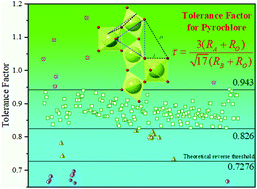
The tolerance factor is a structural indicator that connects the crystal structure and chemical composition. In this work, we establish the tolerance factor for pyrochlore A2B2O7-type compounds, using ionic radii of the compositional species. It is derived following similar procedures to those of perovskite and garnet structures. More than 180 A2B2O7 type compounds are examined to test its validity in predicting the pyrochlore phase stability. It can also be used to understand the reverse and order–disorder cationic occupations. This structural descriptor could be used together with machine learning or high-throughput screening methods for new material design and discovery .

Orange super-long persistent luminescent materials: (Sr1−xBax)3SiO5:Eu2+,Nb5+

Mater. Chem. Front., 2021,5, 333-340. https://doi.org/10.1039/D0QM00488J

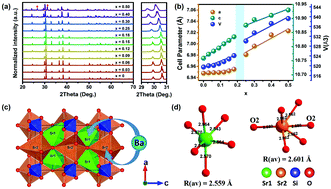
Persistent luminescent materials are widely used as night-vision and marking materials in various important fields. Although significant achievements have been made in blue and green persistent luminescent (PersL) materials, the research and development of PersL materials in the warm-color region (550–660 nm) are relatively lacking. Only the orange PersL phosphor Y2O2S:Eu3+,Mg2+,Ti4+ (∼610 nm) and deep red PersL phosphor (Ca1−xSrx)S:Eu2+,Tm3+ (∼650 nm) fulfill the demands of commercial applications. However, sulfide phosphors have poor chemical stability and a relatively short persistent duration time. Herein, we report a series of orange PersL materials, (Sr1−xBax)3SiO5:Eu2+,Nb5+, which exhibit a strong PersL emission band at 550–670 nm and a super-long persistent time of more than 20 h at the 0.32 mcd m−2 threshold value after UV radiation. These new orange PersL materials are compared to the commercial warm-color sulfide PersL phosphor, Y2O2S:Eu,Mg,Ti, with regards to PersL time and brightness, and it is determined that they would have great potential applications .