
ECS Meeting Abstracts MA2022-02, (51), 1971-1971, 2022. https://doi.org/10.1149/MA2022-02511971mtgabs
Reply to the ‘Comment on “Tolerance factor, phase stability and order-disorder of the pyrochlore structure”’ by M. S. Nickolsky, Inorg. Chem. Front , 2022, 9, DOI: 10.1039/D1QI01267C
Inorganic Chemistry Frontiers 9, (5), 1033-1033, 2022. https://doi.org/10.1039/D2QI00159D
Consequence of optimal bonding on cation ordering and enhanced near-infrared luminescence in Cr3+ -doped pyroxene oxides
Journal of Materials Chemistry C 10, (24), 9232-9240, 2022. https://doi.org/10.1039/D2TC01792J
Energy level diagram of 3d2 configuration in tetrahedral crystal field and its applications to Cr4+ /Mn5+ -Doped luminescent materials
Advanced Theory and Simulations 5, (11), 2200466, 2022. https://doi.org/10.1002/adts.202200466
Ce3+/Eu2+掺杂无机发光材料构效关系与唯象理论
发光学报 43, (9), 1319-1339, 2022.
Cr3+-Doped double perovskite antimonates: efficient and tunable phosphors from NIR-I to NIR-II
Inorganic Chemistry Frontiers 9, (18), 4602-4607, 2022. https://doi.org/10.1039/D2QI01093C
Crystal-Field Splitting in Regular Polyhedron
Chinese Journal of Luminescence 43, (9), 1428-1435, 2022. https://doi.org/10.37188/CJL.20220190
Reversible Mechanically Induced On–Off Photoluminescence in Hybrid Metal Halides
Adv. Funct. Mater., 2022, 32, 13, 2110771. https://doi.org/10.1002/adfm.202110771

Stimulus-responsive photoluminescent materials have attracted extensive research attention in recent years owing to their potential application in information storage and switch devices. It is important to further explore such bistable materials as well as the underlying transformation mechanisms. Herein, the syntheses and mechanically tunable “on–off” photoluminescence (PL) of two organic–inorganic hybrid metal halides, (Bmpip)9Pb3Zn2Br19 and (Bmpip)9Pb3Cd2Br19 (Bmpip+ = 1-butyl-1-methyl-piperidinium, C10H22N+), are reported. Both as-obtained compounds are nonemissive under UV light at ambient conditions but exhibit bright PL upon grinding or under hydrostatic pressure. Interestingly, the PL is quenchable by short-time annealing or storage in air for 1 week, and the process is repeatable. Through a combination of extensive structural and spectral analyses, the crucial role of the organic cations interacting with inorganic chromophores in the “on–off” PL behavior of the title compounds is revealed. Moreover, pressure-induced PL and PL-enhancement phenomena are observed in both compounds, which are similar to but slightly different than the above-mentioned mechano-PL. Finally, proof-of-concept devices are fabricated to demonstrate the potential applications of the title compounds in message recording and force sensing.
Crystallographic control for Cr4+ activators toward efficient NIR-II luminescence
Inorg. Chem. Front., 2022,9, 1912-1919 https://doi.org/10.1039/D2QI00217E
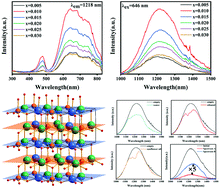
Broadband near-infrared (NIR) emitting phosphors have attracted great interest due to their potential applications in non-destructive examination and bioimaging. However, most of the reported broadband NIR phosphors emit in the NIR-I region with a wavelength shorter than 950 nm, while rare-earth activated NIR-II phosphors can hardly meet the requirements because of their sharp emission. Herein, we successfully synthesized the broadband NIR-II phosphor Li2ZnGeO4:Cr4+. By employing the all-tetrahedron-built matrix, all the Cr ions are stabilized in the tetravalent state due to crystallographic control. This phosphor shows wide absorption from the red to near-infrared region. Under 646 nm excitation, it exhibits broadband NIR-II emission peaking at 1218 nm with an FWHM of 220 nm at room temperature. We also demonstrated the potential applications of Li2ZnGeO4:Cr4+ as an NIR-II light source in non-destructive examination and bioimaging. This work provides a new strategy for exploring broad-band NIR-II luminescent materials.
UV-Red Light-Chargeable Near-Infrared-Persistent Phosphors and Their Applications
ACS Appl. Mater. Interfaces 2022, 14, 1, 1496–1504 https://pubs.acs.org/doi/10.1021/acsami.1c21321

Near-infrared (NIR)-persistent luminescence (PersL) materials are of promising applications in labeling, tracing, bio-imaging, and so forth, featuring distinctive self-sustained NIR light emitting. The PersL radiation spectrum, PersL duration, and charging efficiency are recognized as the key enablers for high-performance NIR PersL materials. Here, we have designed and developed a series of broad-band NIR superlong PersL phosphors (Sr,Ba) (Ga,In)12O19:Cr3+ with efficient UV-red light charging capacity. Typical SrGa10.49In1.5O19:0.01Cr3+ presents intensive NIR PersL from 650 to 1000 nm peaking at ∼770 nm, with a PersL duration of 360 h. This material can be efficiently and repeatedly charged by solar radiation in various outdoor environments. Our work further identifies that this NIR PersL material is advantageous for labeling and tracing as a secret NIR additive and in situ bio-imaging as an optical probe under high tissue penetration red light excitation.
Copyright 2026.北京科技大学 光功能材料与器件实验室. All Rights Reserved.
