Design Optimization of Lead-Free Perovskite Cs2AgInCl6:Bi Nanocrystals with 11.4% Photoluminescence Quantum Yield

Chem. Mater. 2019, 31, 9, 3333–3339. https://pubs.acs.org/doi/abs/10.1021/acs.chemmater.9b00410

Lead-free halide double perovskites continue to draw increasing attention in view of their nontoxicity and stability compared to lead-based perovskites. Herein, we optimized the colloidal synthesis of undoped and Bi-doped Cs2AgInCl6 nanocrystals (NCs) via the facile hot-injection process using nontoxic and available precursors. The synthesis conditions including temperature, ligands, and hydrochloric acid are investigated to boost the photoluminescence quantum yield (PLQY) of Cs2AgInCl6:Bi NCs with the trace amount of Bi doping. The broad-band orange emission peaking at 580 nm is observed with the PLQY as high as ∼11.4%, and the related luminescence mechanism has been discussed. This work provides a reliable avenue toward the optimization of optical properties for emerging lead-free halide perovskite NCs with enhanced PLQY.

Manipulation of Bi3+/In3+ Transmutation and Mn2+‐Doping Effect on the Structure and Optical Properties of Double Perovskite Cs2NaBi1‐xInxCl6

https://onlinelibrary.wiley.com/doi/abs/10.1002/adom.201801435

The halide double perovskite family represented by A2(B+,B3+)X6 can overcome the lead toxicity and enable generally large band gap engineering via B/B sites’ transmutation or exotic dopants to fulfill the emerging applications in the optoelectronic fields. Herein, the design and the experimental synthesis of a new family of Mn2+-doped Cs2NaBi1-xInxCl6 crystals with an intense orange-yellow emission band are reported, and the phase formation stability is discussed via a combined experimental–theoretical approach. Depending on the manipulation of Bi3+/In3+ combination, the band gap increases with In3+ content, and a subsequent evolution from indirect to direct band gap is verified. First-principles calculations and parity analyses indicate a parity forbidden effect on Cs2NaInCl6, and a combination effect of absorption on Cs2NaBi1-xInxCl6 from both Cs2NaBiCl6 and Cs2NaInCl6. The associated Mn2+-doped photoluminescence depending on the Bi3+/In3+ substitution is also addressed from the variation of the different Mn–Cl environment and neighboring-cation effect.

Effects of Neighboring Polyhedron Competition on the 5d Level of Ce3+ in Lanthanide Garnets

https://pubs.acs.org/doi/abs/10.1021/acs.jpcc.9b00395

Abstract Image

Herein, we provide a direct explanation for the reverse garnet effect based on polyhedron competition. On multisite substitution, the deformation of the dodecahedron which will accommodate Ce3+ meets suppression from a neighboring octahedron and tetrahedron. This makes the dodecahedral deformation nonisotropic. Further, it is found that the lowest 5d state of Ce3+ in garnet is closely related to the tetragonal distortion of the dodecahedron, which is characterized by a simplified cuboid model. Crystal-field calculations reveal how the edge-ratio of the cuboid affects energy levels. This model gives a satisfactory explanation for the reverse garnet effect and is helpful for seeking novel garnet-based luminescent materials.

Discovery of New Narrow‐Band Phosphors with the UCr4C4‐Related Type Structure by Alkali Cation Effect

https://onlinelibrary.wiley.com/doi/abs/10.1002/adom.201801631

Narrow-band luminescence materials used in white light-emitting diodes (WLEDs) have demonstrated a great potential to increase the maximum accessible color gamut, improve the color rendition, or enhance the visual luminous efficacy for illumination and display devices. So far, the discovery of narrow-band rare earth doped phosphors for emerging applications remains challenging owing to the limited systems in use and the broadening effect of 4f–5d transition. Here, two narrow-band cyan-emitting phosphors with the UCr4C4-related type structure, RbNa2K(Li3SiO4)4:Eu2+ (RNKLSO:Eu2+) and CsNa2K(Li3SiO4)4:Eu2+ (CNKLSO:Eu2+), are reported. The narrow-band emission results from the highly condensed network and a cube-like site for the activator (Eu2+). The emission peak assignments are investigated, and the variations of luminescence behavior with compositional changes of alkali cations are elaborated in detail. RNKLSO:8% Eu2+ (95%@250 °C of the integrated emission intensity at 25 °C) shows better thermal stability than that of CNKLSO:8% Eu2+ (79%@250 °C), which can be explained by the thermally activated crossover process represented in the configurational coordinate diagram. The optical properties of the as-fabricated WLEDs are studied and demonstrate potential with tunable properties for the full spectrum phosphor-converted LEDs. These findings in UCr4C4-type phases help shedding light on new avenues for fabricating new and totally unexpected narrow-emitting phosphors with versatile applications.

Synthesis and Luminescence Properties of CsPbX3@Uio-67 Composites toward Stable Photoluminescence Convertors

https://pubs.acs.org/doi/abs/10.1021/acs.inorgchem.8b03295

Abstract Image

All-inorganic halide perovskite (CsPbX3, X = Cl, Br, or I) nanocrystals (NCs) have been widely studied due to their outstanding optoelectronic properties. However, some inevitable factors like light, heat, and moisture affected the stability of CsPbX3 NCs and further limited their practical application. In this work, the stability of all-inorganic halide perovskite NCs can be improved by integrating them in the stable Zr-based metal–organic frameworks (Uio-67). Compared to pristine perovskite NCs, typical CsPbBr3@Uio-67 composites display a stable photoluminescence property that can be maintained for 30 days under ambient atmospheric conditions. Due to the proposed confinement effects of CsPbX3 NCs coordinated with the pore structures of Uio-67, the related structural model of CsPbX3@Uio-67 composites was elucidated. White LED device was further fabricated by combining CsPbBr3@Uio-67 composites and commercial K2SiF6:Mn4+ red phosphors with a blue-emitting chip, which demonstrated a wide color gamut (138% of National Television Standards Committee color space). The strategy on encapsulation of CsPbX3 NCs into Uio-67 will open up a stable platform for optoelectronic applications.

Luminescent perovskites: recent advances in theory and experiments

https://pubs.rsc.org/en/content/articlehtml/2019/qi/c9qi00777f

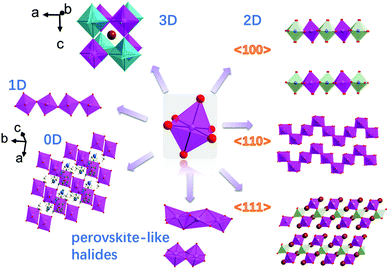
image file: c9qi00777f-f1.tif

Perovskites form an important and enormous class of inorganic compounds. Recently, perovskite materials have attracted extensive research interest owing to their excellent optoelectronic properties. Deep insights into the relationships between the crystal structure, electronic structure and properties play an important role in the development of new functional materials and high-performance devices. In this review, after a brief introduction, we first discuss the crystal structure and crystal chemistry of perovskites according to their three classes: standard perovskites, low-dimensional perovskites and perovskite-like halides. Next, the electronic structure and luminescence from different physical origins are presented. Then, we present a survey on the design, synthesis and luminescence properties of different perovskites, including halide perovskites, oxide perovskites, and lanthanide- or transition metal-doped perovskites, also including dimension-different perovskites (3D, 2D, 1D and quantum dots). We also summarize the strategies for improving the photoluminescence quantum yield (PLQY) and chemical stability, including by surface passivation, encapsulation and doping. Finally, we review their applications and give a brief outlook.

Li substituent tuning of LED phosphors with enhanced efficiency, tunable photoluminescence, and improved thermal stability

https://www.science.org/doi/10.1126/sciadv.aav0363?intcmp=trendmd-adv&

Solid-state phosphor-converted white light-emitting diodes (pc-WLEDs) are currently revolutionizing the lighting industry. To advance the technology, phosphors with high efficiency, tunable photoluminescence, and high thermal stability are required. Here, we demonstrate that a simple lithium incorporation in NaAlSiO4:Eu system enables the simultaneous fulfillment of the three criteria. The Li substitution at Al sites beside Na sites in NaAlSiO4:Eu leads to an enhanced emission intensity/efficiency owing to an effective Eu3+ to Eu2+ reduction, an emission color tuning from yellow to green by tuning the occupation of different Eu sites, and an improvement of luminescence thermal stability as a result of the interplay with Li-related defects. A pc-WLED using the Li-codoped NaAlSiO4:Eu as a green component exhibits improved performance. The phosphors with multiple activator sites can facilitate the positive synergistic effect on luminescence properties.

Controlling Cr3+/Cr4+ concentration in single-phase host toward tailored super-broad near-infrared luminescence for multifunctional applications

Mater. Chem. Today,2021,22,100555.https://doi.org/10.1016/j.mtchem.2021.100555

Full control on the valence of the active ions in solids to improve properties is the central topic of chemistry and materials. Cr3+ and Cr4+ ions generally emit wavelength-different near-infrared (NIR) light. Here, we have developed a chromium valence-controllable single-phase phosphor, Mg2GeO4:Cr3+,Cr4+ to achieve super-broad NIR luminescence. High Li+ content charge compensators can stabilize Cr3+ while high temperature sintering tends to facilitate the formation of Cr4+. Through fine adjusting the synthesis conditions, pure Cr3+ or Cr4+ luminescence can be obtained with peak emission locating at 935 and 1190 nm, respectively. Super-broad-band dual emission spanning from 650 to 1600 nm is realized via fully controlling the concentration ratio of Cr3+ to Cr4+ in single host. By measuring the transmission spectra of several foodstuffs illuminated by our phosphors, nondestructive analysis in food safety area can be realized. This study provides a new strategy for exploiting super-broad-band NIR luminescent materials.

Efficient Near‐infrared Pyroxene Phosphor LiInGe2O6:Cr3+ for NIR Spectroscopy Application

April 2021, Journal of the American Ceramic Society.https://doi.org/10.1111/jace.17856

image\

Broadband near-infrared phosphors are essential to realize nondestructive analysis in food industry and biomedical areas. Efficient long-wavelength (>830 nm) phosphors are strongly desired for practical applications. Herein, we demonstrate an efficient broadband NIR phosphor LiInGe2O6:Cr3+, which exhibits a broad NIR emission peaking at ~880 nm with a full width at half maximum of 172 nm upon 460 nm excitation. The internal/external quantum efficiencies of LiInGe2O6:Cr3+ are measured to be 81.2% and 39.8%, respectively. The absorption of the phosphor matches well with commercial blue LEDs. Using the fabricated phosphor converted LED illuminating human palm, distribution of blood vessels can be clearly recognized under a NIR camera. These results indicate that LiInGe2O6:Cr3+ is a promising candidate to be used in future non-destructive biological applications.