
Thermochromic material Sr2SiO4:Eu2+ based on displacive transformation

J. Lumin., 2014, 152, 199. https://doi.org/10.1016/j.jlumin.2013.11.023.

Strontium silicate Sr2SiO4 undergoes a displacive phase transformation around 85 °C. However, the steady state spectra involved in the process lacks investigation. In this paper, two kinds of Sr2SiO4:Eu2+ with and without Ba ions are synthesized. They are tested for XRD patterns and luminescent spectra at varying temperatures. The results show that Ba ions could effectively suppress the phase transition. For sample without Ba, temperature-dependent XRD patterns confirm the occurrence of phase transition and the emission peak positions at varying temperatures demonstrate a hysteresis behavior. The color of sample heated to 100 °C under UV illumination is distinguishable from that unheated. This structure-sensitive behavior make Sr2SiO4:Eu2+ as potential thermochromic material.
Peak wavelength selection guides of chip and phosphors for phosphor-converted white light-emitting diodes

Rare Met., 2014, 33, 1, 80. https://link.springer.com/article/10.1007/s12598-013-0210-2.

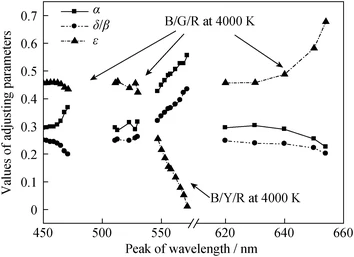
The dependences of light efficiency of radiation (LER) and color-rendering index (CRI) of trichromatic white light-emitting diode (wLED), composed of blue LED die, green/yellow, and red phosphors, on the peak wavelength of each primary were investigated by theoretical calculations, at correlative color temperature (CCT) from 2,700 to 6,500 K. The peak wavelength of InGaN based blue LED chip ranges from 450 to 471 nm, while those of Ca3Sc2Si3O12:Ce3+, b-SiAlON:Eu2+, and Y3Al5O12:Ce3+ based green/yellow phosphors range from 511 to 572 nm, and those of Sr2Si5N8:Eu2+ and CaAlSiN3:Eu2+ red phosphors range from 620 to 650 nm, which cover almost all the practically used, commercially available wave bands until now. Then, based on the results, selection guides of peak wavelengths for blue LED chip and phosphors to obtain tradeoff LER >280 lm·W−1 as well as CRI >80 in all CCTs are proposed. The favorable wave bands of each primary are suggested.

Optimization of light efficacy and angular color uniformity by hybrid phosphor particle size for white light-emitting diode

Rare Met., 2014, 33, 3, 348. https://link.springer.com/article/10.1007/s12598-013-0216-9.

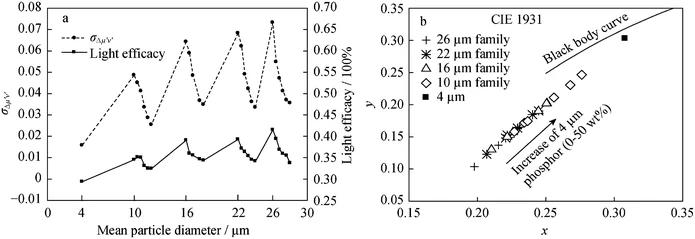
In this study, small- and large-particle-diameter phosphor powders were mixed together (hybrid phosphors) to balance light efficacy and angular color uniformity and pursue optimal results. Phosphor with small-particle-diameter of 4 μm was employed and it was mixed into each large-particle-diameter phosphor of 10, 16, 22, and 26 μm, at mass percentage from 0 % to 50 % with an interval of 10 %, respectively. Remote phosphor package was adopted and overall phosphor concentration was kept constant for better comparison. Moreover, absorption coefficient μ abs, scattering coefficient μ sca and extinction coefficient μ ext of each hybrid phosphors were calculated based on Mie theory to further discuss the experiment results. Results show that, the introduction of small-particle-diameter phosphor to large one can highly improve angular color uniformity while only slightly reduce light efficacy. The optimal performance with angular color uniformity of 91.6 % as well as normalized light efficacy of 95.7 % is achieved in the white light emitting diode with hybrid phosphors consisting of 60 wt% powder of 22 μm and 40 wt% powder of 4 μm.

The synthesis of narrow-band red-emitting SrLiAl3N4:Eu2+ phosphor and improvement of its luminescence properties

J. Mater. Chem. C, 2016,4, 7332-7338. https://doi.org/10.1039/C6TC02093C

In this paper, narrow-band red-emitting SrLiAl3N4:Eu2+ phosphor has been successfully prepared using a solid-state reaction method. The effects of sintering temperatures, times and fluxes on phase formation and luminescence properties are investigated, respectively. The addition of BaF2 flux not only enhances room-temperature emission intensity, but also improves the luminescence thermal stability, which is ascribed to the increase of crystallinity. Under blue light excitation, the as-prepared SrLiAl3N4:Eu2+ phosphor has a narrow emission band with a peak wavelength at ∼648 nm and a full-width at half-maximum of ∼1177 cm−1 (∼50 nm). The critical quenching concentration of Eu2+ is about 1 mol%. White light-emitting-diode (w-LED) devices have been fabricated which are obtained by combining a 455 nm chip with the commercial yellow phosphor and the present red phosphor. The results exhibit a potential application for phosphor-converted LEDs (pc-LEDs).

Relationship between thermal quenching of Eu2+ luminescence and cation ordering in (Ba1-xSrx)2SiO4:Eu phosphors

Journal of Luminescence. 180 (2016) 163–168

The thermal quenching property of phosphors has been proven to have a strong impact on the application of them. In this paper, a series of (Ba1−xSrx)2SiO4:Eu2+ compounds have been synthesized via conventional high-temperature solid-state reaction. Based on the Rietveld fitting analysis of the X-ray diffraction data, the preferential occupancy behavior of Sr2+/Ba2+ ions is verified. We adopt the cation ordering to characterize this preferential occupancy and find that the degree of cation ordering reaches its maximum at x=0.5 and decreases as x deviates from 0.5. The photoluminescence measurements show that the intermediate composition (x=0.5) exhibits the best luminescence thermal stability with T1/2 over 200 °C. The composition dependence of thermal quenching temperature is well similar to the composition dependence of the degree of cation ordering, indicating that the thermal quenching property of (Ba1−xSrx)2SiO4:Eu2+ is positively related to the cation ordering. This work provides a deeper understanding between thermal quenching properties and crystal structures of phosphors.

Evolution of Structure and Photoluminescence by Cation Cosubstitution in Eu2+-Doped (Ca1–xLix)(Al1–xSi1+x)N3 Solid Solutions

Inorg. Chem. 2016, 55, 6, 2929–2933

Red-emitting nitride phosphors excited with blue light have great potential for the fabrication of warm white light-emitting diodes (WLEDs). Chemical composition and structural modification are generally adopted to optimize the photoluminescence behaviors of the targeted phosphors. Herein, on the basis of the famous CaAlSiN3 phosphors, Eu2+-doped (Ca1–xLix)(Al1–xSi1+x)N3 solid solutions via the cations’ cosubstitution of (CaAl)5+ pair by (LiSi)5+ pair are successfully synthesized by a solid state reaction, and the lattice parameters show a linear decrease with chemical compositions suggesting the formation of the isostructural phase relationship. Four types of coordinated structure models, corresponding to different coordination environments of Eu2+, are proposed over the course of structural evolution, which induces different structural rigidity and stability, and then they are responsible for three-stage changes of emission spectra of Eu2+ in (Ca1–xLix)(Al1–xSi1+x)N3 solid solution.

Analysis on stability and consistency of intensity measurement of White Light Emitting Diode phosphors

Optik 127 (2016) 2798–2801

This paper focuses on the stability and consistency of intensity measurements of WLED phosphors. The quality of phosphor products are determined by the measured intensities, but in practice it is often found that intensity measurements cannot be replicated. This problem is due to the instability of test conditions (fluctuating light source power, different paring of quartz lids, etc.) A Monte Carlo ray-tracing model is applied to illustrate the differences in faculae caused by tiny quartz lid slips. The research presented would be particularly beneficial for researchers and manufactures of phosphor .

Charge Transfer, Local Structure, and the Inductive Effect in Rare-Earth-Doped Inorganic Solids

Inorg. Chem. 2018, 57, 19, 12376–12383. https://doi.org/10.1021/acs.inorgchem.8b02141

The charge transfer (CT) process is widely present in inorganic compounds. However, the explanation of this process accounting the inductive effect was not reported. In this work, through the analysis of local structure about the second nearest cations (SNCs) in some compounds doped with trivalent lanthanide, we verify successfully the important role of the inductive effect in the CT process. By introducing electronegativity factor ∑iχi(Ai)/N – x(M), and ionic radius factor ∑iri(Ai)/N, the semiquantitative model is proposed. Strong positive correlation between the electronegativity factor and CT energy and strong negative correlation between the ionic radius factor and CT energy are given. At last, the interrelationship among these two inductive factors, the CT process, the change of local coordination structure, and the chemical composition is revealed. This work will facilitate our understanding of the CT process and the delicate role of the local structure and the inductive effect .

Enhanced performance of Sr2Si5N8: Eu2+ red afterglow phosphor by co-doping with boron and oxygen

Journal of Luminescence 204 (2018) 36–40

Herein we report the improvement in persistent luminescence of Eu2+ doped Sr2Si5N8 nitride phosphor. A systematic experiment has been performed to investigate the influence of co-doping B3+, O2-, Tm3+ in Sr2Si5N8: Eu2+. It is found that B3+ and O2- co-doped Sr2Si5N8: Eu2+ phosphor exhibits better afterglow properties with higher afterglow intensity, which can be attributed to larger trap density. The afterglow luminescence mechanism in Sr2Si5N8: Eu2+, B3+, O2- is discussed on the basis of the host referred binding energy (HRBE) scheme of Sr2Si5N8, the relative energy level positions of 5d and 4 f electron of Eu2+ and the trap depth in the host lattice .

The red persistent luminescence of (Sr,Ca)AlSiN3:Eu2+ and mechanism different to SrAl2O4:Eu2+,Dy3+

Journal of Luminescence, April 2019, 208

(Sr,Ca)AlSiN3:Eu²⁺ phosphors have been widely used in phosphor-converted white light emitting diodes. Herein, we reported the strong red persistent luminescence in (Sr,Ca)AlSiN3:Eu²⁺ under UV light excitation. The Sr0.8Ca0.2AlSiN3:0.15% Eu²⁺ shows the strongest red persistent luminescence with a peak emission wavelength at ~628 nm and a persistent time of ~9600 s at the 0.32 mcd/m² threshold value. A new persistent luminescence mechanism, which is different to that of SrAl2O4:Eu²⁺,Dy³⁺, was proposed by comparing the thermoluminescence excitation spectrum (TLES) and the photoluminescence excitation spectrum (PLES) of Sr0.8Ca0.2AlSiN3:0.15% Eu²⁺. The electrons are directly excited from 4f ground states to the conduction band or from valence band to conduction band in (Sr,Ca)AlSiN3:Eu²⁺; while, in SrAl2O4:Eu²⁺,Dy³⁺, they are first excited to 5d level and then stimulated thermal process to the conduction band. The effect of Eu²⁺ concentration on red persistent luminescence in (Sr,Ca)AlSiN3:Eu²⁺ were discussed. The proposed mechanism of persistent luminescence can help us to design and find new persistent luminescence materials .