The Inductive Effect in Nitridosilicates and Oxysilicates and Its Effects on 5d Energy Levels of Ce3+

Inorg. Chem. 2018, 57, 4, 2320–2331. https://doi.org/10.1021/acs.inorgchem.7b03253

The inductive effect exists widely in inorganic compounds and accounts well for many physicochemical properties. However, until now this effect has not been characterized quantitatively. In this work, we collected and analyzed the structural data of more than 100 nitridosilicates and oxysilicates, whose structures typically consist of [SiN4] or [SiO4] tetrahedra. We introduce a new parameter, the inductive effect factor μΔχ, related to the difference of electronegativity between constituent metal elements and silicon. Then, a linear relationship is established between average length of Si–N/Si–O bonds and the inductive factor with the help of statistical method, that is, l̅ = 1.7313 + 0.0166 μΔχ (Å) with adjusted (adj) R2 = 0.800 for Si–N and l̅ = 1.6221 + 0.0035 μΔχ(Å) with adj R2 = 0.240 for Si–O. Furthermore, our research shows that the distinct positive correlation does exist between the inductive factor and the centroid shift of 5d levels of Ce3+. This work will help us understanding the inductive effect deeply and quantitatively .

After-glow, luminescent thermal quenching, and energy band structure of Ce-doped yttrium aluminum-gallium garnets

Journal of Luminescence, 2017,9, 192

Yttrium aluminum-gallium garnets with cerium doped is most widely used as green-yellow phosphor in solid state lighting. Extensive research has been performed on this material concerning the luminescent thermal quenching resistance and persistent luminescence. In this paper we find that a negative correlation exists between temperature-dependent luminescence and persistent luminescence with gallium content varying. The correlation originates from the electronic structures which influence both the thermal quenching of luminescence and persistent luminescence. A detailed crystal-field calculation has been performed to understand the peak shifts. In addition, theoretical calculations reveal that oxygen vacancies provide trap levels which implement the persistent luminescence. This material could be used as potential blue-light excited persistent luminescent material, with the after-glow time up to about 1. h with only cerium as the dopant, which is expected to be prolonged by co-doping other elements. This work may be helpful in guiding the discovery of other after-glow materials .

Control of Luminescence in Eu2+-Doped Orthosilicate-Orthophosphate Phosphors by Chainlike Polyhedra and Electronic Structures

Inorg. Chem. 2018, 57, 2, 609–616. https://doi.org/10.1021/acs.inorgchem.7b02431

A series of Eu2+-doped orthosilicate-orthophosphate solid-solution phosphors, KxBa1.97–x(Si1–xPx)O4:0.03Eu2+, have been synthesized via the conventional solid-state reaction. Using varying compositions, the lowest-energy excitation can be tuned from 470 to 405 nm, with an emission from 515 to 423 nm. We determined how chainlike cation polyhedra controlled excitation- and emission-band features by introducing in-chain characteristic length d22 and outside-chain characteristic length d12 and that there was a nearly linear relationship between the lowest-energy-excitation position and the ratio of d22 to d12. This influence of chainlike polyhedra on luminescence can be understood through the inductive effect. Luminescent thermal properties are improved remarkably by the cosubstitution of K+ and P5+ ions for Ba2+ and Si4+ ions with a T1/2 over 200 °C. We have established the host-referred-binding-energy (HRBE) and vacuum-referred-binding-energy (VRBE) schemes for the electronic structure of the series of lanthanide-doped phosphors according to the Dorenbos model and given a thermal-quenching mechanism for this series of phosphors .


Crystal Structure and Photoluminescence Evolution of La5(Si2+xB1–x)(O13–xNx):Ce3+ Solid Solution Phosphors

J. Phys. Chem. C., 2015, 119, 17, 9488. https://pubs.acs.org/doi/10.1021/acs.jpcc.5b01211

A series of iso-structural La5(Si2+xB1–x)(O13–xNx):Ce3+ phosphors with apatite structure have been prepared. A combination of powder X-ray diffraction and neutron scattering technique was employed to explore the crystal structural evolution and the rigid nature from oxy- to oxynitride-based apatites, and some local structures were also characterized by HRTEM and 29Si NMR data, respectively. The new La5(Si2+xB1–x)(O13–xNx):Ce3+ solid solution phosphors gave continuously controlled emission from 421 nm [La5Si2BO13:Ce3+, end-member (x = 0)] to 463 nm (La5Si3O12N:Ce3+, end-member (x = 1)). Substitution of B3+ and O2– by Si4+ and N3– in La5(Si2+xB1–x)(O13–xNx):Ce3+ phosphors produced more covalency into the crystal field environment around the Ce3+ ions inducing the red-shifted emission, further improving the thermal stability of the oxynitride-based apatite phosphors. The proposed approach from oxy- to oxynitride based iso-structural phases could significantly contribute to future research in designing complex solid solution phosphors .

Consequence of Optimal Bonding on Disordered Structure and Improved Luminescence Properties in T-Phase (Ba,Ca)2SiO4:Eu2+ Phosphor

Inorg. Chem. 2018, 57, 7, 4146–4154. https://doi.org/10.1021/acs.inorgchem.8b0036

T-phase (Ba,Ca)2SiO4:Eu2+, showing excellent luminescent thermal stability, has a positionally disordered structure with the splitting of five atom sites, but until now the reason has remained unclear. Herein, we investigate the coordination environments of each cation site in detail to understand the origins of the atom site splitting. We find that the three cation sites in the split-atom-site model are optimally bonded with ligand O atoms compared to the unsplit-atom-site model. This atom site splitting results in larger room and smaller room for each splitting cation site, which just accommodates larger Ba2+ ions and smaller Ca2+ ions, respectively, leading to more rigid structure. Based on the X-ray diffraction data refinement, the boundary of the T-phase for (Ba1–xCax)2SiO4 is redetermined. The Eu2+-doped T-phase (Ba,Ca)2SiO4 phosphors show excellent luminescent thermal stability, which can be attributed to optimal bonding and more rigid structure with atom site splitting. These results indicate that T-phase (Ba,Ca)2SiO4:Eu2+ phosphors have promise for practical applications .

Complementary method to locate atomic coordinates by combined searching method of structure-sensitive indexes based on bond valence method

Chin. Phys. B., 2015, 24, 106101. https://iopscience.iop.org/article/10.1088/1674-1056/24/10/106101

Bond valence method illustrates the relation between valence and length of a particular bond type. This theory has been used to predict structure information, but the effect is very limited. In this paper, two indexes, i.e., global instability index (GII) and bond strain index (BSI), are adopted as a judgment of a search-match program for prediction. The results show that with GII and BSI combined as judgment, the predicted atom positions are very close to real ones. The mechanism and validity of this searching program are also discussed. The GII & BSI distribution contour map reveals that the predicted function is a reflection of exponential feature of bond valence formula. This combined searching method may be integrated with other structure-determination method, and may be helpful in refining and testifying light atom positions .

Chemical Unit Cosubstitution and Tuning of Photoluminescence in the Ca2(Al1–xMgx)(Al1–xSi1+x)O7:Eu2+ Phosphor

J. Am. Chem. Soc., 2015, 137, 39, 12494. https://pubs.acs.org/doi/10.1021/jacs.5b08315.

The union of structural and spectroscopic modeling can accelerate the discovery and improvement of phosphor materials if guided by an appropriate principle. Herein, we describe the concept of “chemical unit cosubstitution” as one such potential design scheme. We corroborate this strategy experimentally and computationally by applying it to the Ca2(Al1–xMgx)(Al1–xSi1+x)O7:Eu2+ solid solution phosphor. The cosubstitution is shown to be restricted to tetrahedral sites, which enables the tuning of luminescent properties. The emission peaks shift from 513 to 538 nm with a decreasing Stokes shift, which has been simulated by a crystal-field model. The correlation between the 5d crystal-field splitting of Eu2+ ions and the local geometry structure of the substituted sites is also revealed. Moreover, an energy decrease of the electron–phonon coupling effect is explained on the basis of the configurational coordinate model .
 

Synthesis, structure and tunable red emissions of Ca(Al/Si)2N2(N1−xOx):Eu2+prepared by alloy-nitridation method

J. Lumin., 2013, 137, 173. https://doi.org/10.1016/j.jlumin.2012.12.053

 A series of phosphors, Eu-doped Ca(Al/Si)2N2(N1−xOx), derivatives of CaAlSiN3, were synthesized by alloy-nitridation method. We demonstrated that their emission peaks can be tuned from 650 nm to 610 nm by oxygen preferential substitutions of nitrogen located at one of two crystallographic sites. Two luminescent centers corresponding to two types of Eu2+-coordination modes, i.e. EuNI2NII3 and EuNI2NII2O, were identified and accounted for the emission band structures, emission band shifts with oxygen/nitrogen substitutions, and the dependence of peak position and integrated emission intensity on temperature. As a typical example, Ca(Al/Si)2N2(N0.80O0.20):0.02Eu showed intense orange–red emission peaking at 622 nm and kept the feature of excellent chemical stabilities, which would have potential applications in fabricating the white light-emitting diode. The excellent luminescent properties of these materials, such as wavelength-tunable red emission and excellent chemical stabilities, make them practical for use in typical LED package .

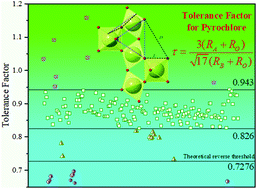
Tolerance factor, phase stability and order–disorder of the pyrochlore structure

Inorg. Chem. Front., 2020,7, 1583-1590. https://doi.org/10.1039/D0QI00016G

Graphical abstract: Tolerance factor, phase stability and order–disorder of the pyrochlore structure

The tolerance factor is a structural indicator that connects the crystal structure and chemical composition. In this work, we establish the tolerance factor for pyrochlore A2B2O7-type compounds, using ionic radii of the compositional species. It is derived following similar procedures to those of perovskite and garnet structures. More than 180 A2B2O7 type compounds are examined to test its validity in predicting the pyrochlore phase stability. It can also be used to understand the reverse and order–disorder cationic occupations. This structural descriptor could be used together with machine learning or high-throughput screening methods for new material design and discovery .

Synthesis of YAG phosphor particles with excellent morphology by solid state reaction

J. Cryst. Growth., 2013, 365, 24. https://doi.org/10.1016/j.jcrysgro.2012.12.022

Cerium doped yttrium aluminum garnet (YAG:Ce) has been chosen as WLED phosphors for its appropriate spectral property. However, YAG powders synthesized by several methods do not satisfy commercial requirements in mobility, size distribution, luminescent intensity, etc. With flux added in the synthesis, well-shaped crystallites can nucleate and grow in the wetted micro domains. High temperature compensates the adverse effect of intermediate product on particle size. The final products are phosphor powders composed of uniformly distributed large particles. Preferred orientation in the XRD patterns confirms that the isolated particles are single crystals other than agglomeration of fine grains. This kind of phosphors has a better performance in WLED devices. This work will improve the commercial production of WLED phosphors .