
Conductivity, thermoelectric, and magnetic properties of pavonite homologue In0.45Mn2.17Bi3.38Se8 with N=3

Journal of Alloys and Compounds Volume 960, 15 October 2023, 170895, https://doi.org/10.1016/j.jallcom.2023.170895

Pavonite homologues are semiconductors that show potential for thermoelectric applications. Herein, we report the synthesis of a quaternary selenide, In0.5Mn2Bi3.5Se8, that exhibits good thermal stability below 1032 K. Whereas most pavonite compounds exhibit the metallic properties of degenerate semiconductors, In0.45Mn2.17Bi3.38Se8 possesses a band gap of 0.85 eV. In addition, its electrical conductivity and Seebeck coefficient exceed 3 S/cm and 300 μV/K at 810 K, respectively, with the compound mainly displaying semiconductor properties. In0.45Mn2.17Bi3.38Se8 exhibits paramagnetism at room temperature followed by a paramagnetic-to-antiferromagnetic transition at ∼10.2 K. Our findings enrich the current understanding of the pavonite homologous series, providing useful insight for future exploration in related fields.
Tunable Bright White Light Emission with Ultra-High Color Rendering Index Induced by Trigonal Bipyramid Unit

ADVANCED OPTICAL MATERIALS, 2023-02-04, https://doi.org/10.1002/adom.202202304

Efficient broadband emitting organic–inorganic metal hybrids (OIMHs) have attracted great attention recently as promising single-component white light emitters. Here a new zero-dimensional (0D) OIMH (C13H14N)2InCl5 (C13H14N+ = N-methyldiphenylammonium) is reported, which features unique five-coordinated [InCl5]2− trigonal bipyramid motif. For the first time, it is demonstrated that the trigonal bipyramid units in 0D OIMH can act as luminescence centers, showing blue emission under UV light. Remarkably, incorporating Sb3+ in [InCl5]2− trigonal bipyramids induces a new dual-band emission at 540 and 735 nm resulting from the singlet and triplet self-trapped excitons in [SbCl5]2−, leading to complete coverage of the entire visible spectrum. The resulting emissions in (C13H14N)2InCl5:Sb3+ are tunable from cold to warm white with the correlated color temperatures changing from 5574 to 3473 K and more importantly, an ultra-high color rendering index (CRI) up to 96 being observed, which is comparable to the highest value in hybrid metal halides. A high photoluminescence quantum yield of 46.26% is simultaneously obtained in this system. This work demonstrates that the 0D OIMH with trigonal bipyramid motif is an excellent system for realizing the single-component white light emission with both high efficiency and ultra-high CRI.

Achieving efficient violet-light-excited blue phosphors by nitridation for violet-chip-based full-spectrum lighting


Inorg. Chem. Front.
, 2023,10, 2430-2437.https://pubs.rsc.org/en/content/articlelanding/2023/QI/D2QI02489F

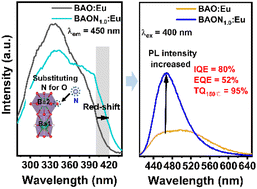
With the pursuit of healthy lighting, full-spectrum white light-emitting diodes (WLEDs) fabricated with violet chips and tri-color phosphors have been put forward. However, the excitation bands of most reported blue phosphors are located in the ultraviolet (UV) region, which hinders the development of full-spectrum lighting. In this work, by partially introducing N3− into a matrix, a series of Ba0.697Al10.914O17.232-3y/2Ny:0.16Eu2+ (BAONy:Eu) blue phosphors with red-shifted photoluminescence excitation (PLE) spectra were synthesized. Under the excitation of 400 nm violet light, the internal/external quantum efficiency (IQE/EQE) values of the optimal sample BAON1.0:Eu were calculated to be 80%/52%, while the retained integrated emission intensity at 150 °C can be 95% of that at room temperature. The WLED device fabricated by coating BAON1.0:Eu and other commercial phosphors on a violet chip achieved an ultra-high color rendering index (Ra = 95.4). These results indicate that our synthesized BAON1.0:Eu can be an excellent candidate blue phosphor for full-spectrum WLED lighting.