定态微扰论

1. 定态微扰论

1.1 简介

量子力学中研究保守物理体系(即)哈密顿算符不明显地依赖于时间的体系)是以哈密顿算符的本征值方程为基础的。

两个重要例子:

简谐振子 特点:√ 哈密顿算符非常简单

氢原子 特点:√ 本征方程可精确求解

然而,仅有少数体系可精确求解。

一般情况下,方程过于复杂,无法求得解析解。

例如:无法精确求解多电子原子体系,哪怕是仅多了一个电子的氦原子。

近似方法:解析地求得基本的本征值方程的近似解

定态微扰论:应用极其广泛,很符合物理学家的口味

①首先突出主要的效应,也就是决定该现象或该体系全貌的那些效应

②理解了这些问题之后,再考虑在一级近似中忽略了的次要效应,并尝试着去解释更“精细”的细节

③正是在处理这些次要效应时,需要应用微扰理论。

1.2 Nondegenerate perturbation theory

非简并微扰:

微扰论适用的前提条件

①体系的哈密顿量H 可写成如下形式:
$$H = {H_0} + W$$

其中H0 的本征态和本征值已知,W远小于H0算符怎么比大小?

②实际上指的是W的矩阵元要远小于H0;

③H0与时间无关,称为非微扰哈密顿量(unperturbed Hamiltonian),而W称为微扰;

④如果W也与时间无关,则称为定态微扰;

⑤求解微扰造成的能级和波函数变化。

基本假设与方法

假设W正比于一个实数λ,其无量纲且远小于1。
$$W = \lambda \hat W$$
$$\lambda \ 1$$

算符 W ̂ 的矩阵元与H0可比(comparable)

一句话弄懂微扰理论:

将H的本征值和本征态按λ幂次展开,保留有限项。

具体步骤

①假设未微扰哈密顿量H0 的本征态与本征值已知;

②假设上述本征值构成分立谱(discrete spectrum),并可以用一个整数序号p代表:Ep0;

③对应的本征态可表示为 |$\varphi _p^i$〉,多余的序号i用于简并态Ep0,区分本征子空间中的正交归一基矢。
$${H_0}|\varphi _p^i\rangle = E_p^0|\varphi _p^i\rangle $$
$$\langle \varphi p^i|\varphi {p’}^{i’}\rangle = {\delta {pp’}}{\delta {ii’}},\sum\limits_p {\sum\limits_i {|\varphi _p^{\mathop i\limits^. }\rangle \langle \varphi _p^{\mathop i\limits^. }| = I} } $$

微扰强度λ

$$H(\lambda ) = {H_0} + \lambda \hat W$$

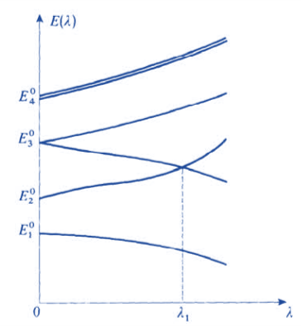
① 体系的哈密顿量可看作λ 的函数,而λ 则表征微扰的强度大小;

② λ 等于0,H(λ) 等于未微扰的哈密顿量H0;

③ H(λ) 的本征值E(λ) 一般情况下与λ有关;

④ 每条曲线都对应着H(λ)的一个本征矢;

⑤ 每一个λ对应的若干本征矢构成矢量空间的一组基矢;

⑥ H(λ) 可以存在简并;

⑦ 当λ→0时,不同E(λ)可以趋近同一个未微扰本征值 Ep0。
1.3 H(λ) 本征方程的近似解

问题描述:

① 寻找H(λ)的本征态 |ψ(λ)〉和本征值E(λ)

$$H(\lambda )|\psi (\lambda )\rangle = E(\lambda )|\psi (\lambda )\rangle $$

②假设E(λ)和|ψ(λ)>可按λ幂次展开:

$$E(\lambda ) = {\varepsilon _0} + \lambda {\varepsilon _1} + … + {\lambda ^q}{\varepsilon _q} + …$$

$$|\psi (\lambda )\rangle = |0\rangle + \lambda |1\rangle + … + {\lambda ^q}|q\rangle + …$$

注意这个写法,与前面右矢的标记不同。

③ 替换 $({H_0} + \lambda \hat W)\left[ {\sum\limits_{q = 0}^\infty {{\lambda ^q}} |q\rangle } \right] = [\sum\limits_{q’ = 0}^\infty {{\lambda ^{q’}}} {\varepsilon {q’}}]\left[ {\sum\limits{q = 0}^\infty {{\lambda ^q}} |q\rangle } \right]$

④ λ取任意值(小),等式两侧都应成立;

⑤ 为此要求两侧相同λ幂次的系数相等

$$({H_0} + \lambda \hat W)\left[ {\sum\limits_{q = 0}^\infty {{\lambda ^q}} |q\rangle } \right] = [\sum\limits_{q’ = 0}^\infty {{\lambda ^{q’}}} {\varepsilon {q’}}]\left[ {\sum\limits{q = 0}^\infty {{\lambda ^q}} |q\rangle } \right]$$

· For 0th-order terms in λ

$${H_0}|0\rangle = {\varepsilon _0}|0\rangle $$

· For 1st-order terms in λ

$$({H_0} – {\varepsilon _0})|1\rangle + (\hat W – {\varepsilon _1})|0\rangle = 0$$

· For 2nd-order terms in λ

$$({H_0} – {\varepsilon _0})|2\rangle + (\hat W – {\varepsilon _1})|1\rangle – {\varepsilon _2}|0\rangle = 0$$

· For qth-order terms in λ

$$({H_0} – {\varepsilon _0})|q\rangle + (\hat W – {\varepsilon _1})|q – 1\rangle – {\varepsilon _2}|q – 2\rangle \; – {\varepsilon _q}|0\rangle = 0$$

只关注前三个等式,即忽略λ2以上的项

前面学过,本征方程

$$H(\lambda )|\psi (\lambda )\rangle = E(\lambda )|\psi (\lambda )\rangle $$

所确定的 |ψ(λ)> 可与任意系数相乘。

因此,可按以下规则选取|ψ(λ)> 的模和相角(相位因子)

· |ψ(λ)>归一化;

· 调整相角,使得内积<0|ψ(λ)> 为实数。

对于0级小,这意味着用 |0> 表示的矢量是归一化的

$$\langle 0|0\rangle = 1$$

此时相角任意选择

对于1级小,矢量|ψ(λ)>模的平方可写为:

$$\langle \psi (\lambda )|\psi (\lambda )\rangle = [\langle 0| + \lambda \;\langle \;1|][|0\rangle + \lambda |1\rangle ] + O({\lambda ^2})$$

$$ = \;\langle \;0|0\rangle + \lambda [\langle 1|0\rangle + \langle 0|1\rangle ] + O({\lambda ^2})$$

要令上式等于1,则 λ的一次项应等于0

选择相角,使<0|1>为实数(λ为实数),则可以得到

$$\langle 0|1\rangle = \langle 1|0\rangle = 0$$

注意这是一个人为选择的结果

类似地,讨论λ的二级小,可以得到

$$\langle 0|2\rangle = \langle 2|0\rangle = – \frac{1}{2}\langle 1|1\rangle $$

推广到q级小,则有

$$\eqalign{
& \langle 0|q\rangle = \langle q|0\rangle = – \frac{1}{2}[\langle q – {\text{1}}|1\rangle + \langle q – 2|2\rangle + … \cr
& {\text{ }} + \langle 2|q – 2\rangle + \langle 1|q – 1\rangle ] \cr} $$

1.4 The perturbation subspace

微扰子空间

$${H_0}|0\rangle = {\varepsilon _0}|0\rangle $$

上式说明,|0>是 H0 具有本征值 ε0的本征矢;

ε0属于H0 的能量谱,因为H(λ)的每一个本征值,当λ→0时都会趋近于其中一个未微扰的能级;

不妨令ε0 = E0,则当λ→0时,会有一个或多个不同的E(λ) 趋近于En0;

考虑这些属于上述E(λ)的本征态;

这些本征矢张开一个子空间,当λ在0附近变化时,其维度不能突变

最终,子空间的维度等于En0的简并度 gn

特别地,如果En0是非简并,则仅能对应一个本征值E(λ), 且该能级是非简并的

一直到这里,并未区分能级简并与否

1.5 Perturbation of a non-degenerate level

非简并能级的微扰: 注意:微扰的对象是能级,而非体系

· 考虑未微扰哈密顿量H0的非简并能级En0,其本征态为|φn> 注意这个符号,小写的。

· 目标:微扰W作用后能级和定态波函数的变化;

· 对于H(λ)当λ→0时趋近于En0 的本征值,存在关系:

$${\varepsilon _0} = E_n^0$$

· 这表明|0> 正比于|φn>。

· p|0>和|φn>都是归一化的,因此选择

$$|0\rangle = |{\varphi _n}\rangle $$

这样,当 λ→0时,就又得到了具有相同相角的未微扰态 |φn>

H(λ)的本征值En(λ) ,当 λ→0时趋近于H0的本征值En0

假设λ 足够小,这样本征值仍然是非简并的,即只对应于一个特定的 |ψn(λ)>。

1.6 First-order corrections一级修正

p先确定ε1 和|1>

Energy correction能量修正

$$({H_0} – {\varepsilon _0})|1\rangle + (\hat W – {\varepsilon _1})|0\rangle = 0$$

将上式投影至|φn>, 可得

$$\langle {\varphi _n}|({H_0} – {\varepsilon _0})|1\rangle + \langle {\varphi _n}|(\hat W – {\varepsilon _1})|0\rangle = 0$$

第一项等于0,因为|φn>=|0> 是H0的本征态,其本征值为 En0=ε0

$${\varepsilon _1} = \langle {\varphi _n}|\hat W|0\rangle = \langle {\varphi _n}|\hat W|{\varphi _n}\rangle $$

$${\varepsilon _1} = \langle {\varphi _n}|\hat W|0\rangle = \langle {\varphi _n}|\hat W|{\varphi _n}\rangle $$

在非简并态的情况下,对应于En0 的 H 的本征值En(λ) 在微扰的一级修正下可写为

$${E_n}(\lambda ) = E_n^0 + \langle {\varphi _n}|W|{\varphi _n}\rangle + O({\lambda ^2})$$

$W = \lambda \hat W$ 注意两个W的区别

因此,能量的一级修正,等于微扰项在未微扰态|φn>中的平均值

刘泉林/Liu Quanlin 博士/Phd,教授/Prof

刘泉林 北京科技大学材料科学与工程学院教授、博士生导师。1970年1月出生于山东垦利县。1992年于西南科技大学地质勘查专业本科毕业,1995年于中国地质大学(北京)矿物学专业获理学硕士学位,1998年于中科院物理研究所凝聚态物理专业获理学博士学位。中科院物理研究所助理研究员(1998-2000年),副研究员(2000-2005),北京科技大学教授(2005年-)。期间,日本国家材料研究所STA 博士后(2001.1-2003.1)和访问学者(2003.10-2004.3)。长期从事光功能材料与器件的研究。主持或参加了国家自然科学基金(11项)、国家重点研发项目、国家“863计划”及其他多个项目。 迄今合作发表SCI学术论文300余篇,论文被引用22000多次,获得授权发明专利10余项。兼任中国物理学会X射线衍射专业委员会委员,中国稀土学会发光专业委员会委员、固体科学与新材料专业委员会委员、稀土晶体专业委员会委员,中国金属学会功能材料分会委员。曾任材料物理与化学系主任(2016-2022),是国家一流本科专业(材料物理专业)建设首任负责人。主讲本科生课《统计物理》、《晶体学基础》和《材料科学与工程导论-名师课堂》,以及研究生课《材料分析方法》(该课每学期选课学生达800多人)。2021年获北京科技大学第22届“我爱我师-我心目中最优秀的老师”荣誉称号。荣获北京市科学技术奖一等奖(2005),广东省科技进步奖二等奖(2019),稀土科学技术奖一等奖(2021),教育部自然科学奖二等奖(2022)。连续入选斯坦福大学全球前2%顶尖科学家,2025年入选科睿唯安全球高被引科学家。

Lead-Free Double Perovskite Cs2AgInCl6

Angew. Chem. Int. Ed., 2021, 60(21): 11592-11603, https://doi.org/10.1002/anie.202011833

Lead-free halide perovskites have drawn wide attention as alternatives to their toxic and poorly stable lead-based counterparts. Among them, double perovskites with Cs2AgInCl6 composition, often doped with various elements, have been in the spotlight owing to their intriguing optical properties, namely, self-trapped exciton (STEs) emission and dopant-induced photoluminescence. This interest has sparked different synthesis approaches towards both crystals and nanocrystals, and the exploration of many alloy compositions with mono- and trivalent cations other than Ag+ and In3+. In this Minireview we describe the recent developments on Cs2AgInCl6 bulk crystals and nanocrystals, their synthesis strategies, intrinsic optical properties, and tunable photoluminescence originating from different alloying and doping effects. We also discuss progress on computational studies aimed at understanding the thermodynamic stability, the role of defects, and the origin of photoluminescence in relation to the STEs and the direct band gap character.

Two Hybrid Metal Halide Infrared Nonlinear Optical Crystals with High Stability:(TMEDA)MI5 (M = Sb, Bi).

Adv. Opt. Mater., 2021, 9, 14, 2101333, https://doi.org/10.1002/adom.202101333

Organic–inorganic metal halides (OIMHs) with unique structural flexibility possess excellent photoelectric properties. They are regarded as next-generation photovoltaic materials, phosphors, semiconductors, and ferroelectrics. The metal-halide units in OIMHs are good microscopic building blocks of nonlinear optical crystals for laser wavelength conversion. However, most OIMHs are absent from nonlinear optics owing to their macroscopic nonlinear optical (NLO)-inactive centrosymmetric crystal structure. In this study, two new lead-free OIMHs, (TMEDA)SbI5 and (TMEDA)BiI5 (where TMEDA2+ is N,N,N′-trimethylethylenediammonium), having 1D structure, crystallized in the orthorhombic system with a non-centrosymmetric P212121 space group, are synthesized. Remarkably, upon 2090 nm laser irradiation, both compounds possess a strong infrared (IR) nonlinear optical response of the same magnitude as AgGaS2, which is a benchmark semiconductor-type nonlinear optical crystal. In addition, under the excitation of ultraviolet and visible lights, both compounds produce self-trapped exciton-induced red-light emission. First-principles electronic structure calculations reveal that the optical properties originate from the electronic transitions within the inorganic metal-halide group. The obtained results indicate that both compounds are potential photoelectric materials for laser frequency conversion and fluorescence, and the observation of NLO effect in these two compounds verifies that OIMHs are also good candidates for NLO crystals.

Broad Photoluminescence and Second-Harmonic Generation in the Non-Centrosymmetric Organic–Inorganic Hybrid Halide (C6H5(CH2)4NH3)4MX7·H2O (M = Bi, In, X = Br or I).

Chem. Mater., 2021, 33, 20, 8106–8111, https://doi.org/10.1021/acs.chemmater.1c02896

Recent discoveries in organic−inorganic metal halides reveal superior semiconducting and polarization properties. Herein, we report three organic–inorganic metal halides, (PBA)4BiBr7·H2O, (PBA)4BiI7·H2O, and (PBA)4InBr7·H2O [(PBA)+ = C6H5(CH2)4NH3+], with band gaps of ∼3.52, ∼2.29, and ∼4.05 eV, respectively. They possess zero-dimensional structures containing the inorganic octahedra [MX6]3– (M = Bi, In, X = Br, I) and unbound X– ions and crystallize in the C2 space group. (PBA)4BiI7·H2O shows a second-harmonic-generation (SHG) response in the infrared region, approximately 1.3 times that of AgGaS2; (PBA)4BiBr7·H2O and (PBA)4InBr7·H2O show SHG responses in the ultraviolet region, approximately 0.4 and 0.6 times that of KH2PO4, respectively. The large SHG responses are attributed to the synergistic contribution of the octahedral distortion of [MX6]3– (M = Bi, In, X = Br, I) and the ordered arrangement of the benzene ring-containing organic cation PBA+. Upon ultraviolet and visible-light excitations at room temperature, (PBA)4BiBr7·H2O, (PBA)4BiI7·H2O, and (PBA)4InBr7·H2O exhibit broad red-light luminescence with large Stokes shifts of 290, 237, and 360 nm, respectively, due to self-trapped exciton emission. All of these properties demonstrate that this series of metal halides are potential multifunctional optoelectronic materials.

Light-Emitting 0D Hybrid Metal Halide (C3H12N2)2Sb2Cl10 with Antimony Dimers.

Inorg. Chem., 2021, 60, 15, 11429–11434. https://doi.org/10.1021/acs.inorgchem.1c01440

Low-dimensional organic–inorganic metal halides (OIMHs), as emerging light-emitting materials, have aroused widespread attention owing to their unique structural tunability and photoelectric characteristics. OIMHs are also promising materials for optoelectronic equipment, light-emitting diodes, and photodetectors. In this study, (C3H12N2)2Sb2Cl10 (C3H12N22+ is an N-methylethylenediamine cation), a new zero-dimensional OIMH, has been reported, and (C3H12N2)2Sb2Cl10 possesses a P21/n space group. The (C3H12N2)2Sb2Cl10 structure contains [Sb2Cl10]4– dimers (composed of two edge-sharing [SbCl6]3– octahedra) that are surrounded by C3H12N22+ cations. The experimental band gap of (C3H12N2)2Sb2Cl10 is 3.80 eV, and density functional theory calculation demonstrates that (C3H12N2)2Sb2Cl10 possesses a direct band gap, with the edge of the band gap mainly contributed from the inorganic units. (C3H12N2)2Sb2Cl10 exhibits good ambient and thermal stability. Under 395 nm excitation at room temperature, (C3H12N2)2Sb2Cl10 exhibits a broad emission with a full width at half-maximum of ∼114 nm, peaking at 480 nm, and the broad emission was ascribed to self-trapped exciton emission.

In4Pb5.5Sb5S19: A Stable Quaternary Chalcogenide with Low Thermal Conductivity.

Inorg. Chem., 2021, 60, 1, 325-333. https://doi.org/10.1021/acs.inorgchem.0c02966

Transition-metal-based chalcogenides are a series of intriguing semiconductors with applications spanning various fields because of their rich structure and numerous functionalities. This paper reports the crystal structure and basic physical properties of a new quaternary chalcogenide In4Pb5.5Sb5S19. The crystal structure of In4Pb5.5Sb5S19 was determined by both powder and single-crystal X-ray diffraction techniques. In4Pb5.5Sb5S19 crystallizes in the monoclinic system with I2/m space group, and the structure parameters are a = 26.483 Å, b = 3.899 Å, c = 32.696 Å, and β = 111.86°. The polyhedral double chains of Sb3+ and Sb/Pb2+ as the main cations are parallel to each other and form a Jamesonite-like mineral structure through the short chain links of the distorted In, Pb, and Sb polyhedron. In4Pb5.5Sb5S19 exhibits a moderate experimental band gap of 1.42 eV, indicating its potential for application in solar cells and photocatalysis. In addition, In4Pb5.5Sb5S19 exhibits good ambient stability, and differential scanning calorimetry tests demonstrate that it is stable up to 892 K in a nitrogen atmosphere. Moreover, In4Pb5.5Sb5S19 exhibits extremely low thermal conductivity (0.438–0.478 W m–1 K–1 ranging from 300 to 700 K) compared with binary counterparts such as PbS and In2S3. Future chemical manipulation via elemental doping or defect engineering may make the title compound a potential thermoelectric or thermal insulating material.

Pavonite homologues as potential n-type thermoelectric materials: crystal structure and performance.

Mater. Chem. Front., 2021, 5(3): 1283-1294. https://doi.org/10.1039/D0QM00662A

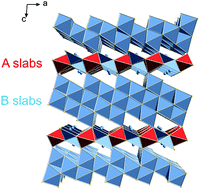
Themoelectric materials exhibit great potential in alleviating the energy shortage and environmental pollution. The development of homologous series is helpful for understanding the relationship between structure and properties, thereby providing new strategies for seeking high-performance thermoelectric materials. Among the various structure prototypes, pavonite is a rising star and has received increasing attention as a potential n-type thermoelectric material owing to their diverse structures and extremely low thermal conductivity. In this review, we summarized the structural characteristics of pavonite and introduced the relationship between structure and thermoelectric performance. The pavonite structure consists of two alternating slabs with separately tunable thicknesses, and has wide adaptability for elemental substitution. Specifically, the participation of heavy atoms in the pavonite structure results in large unit cell volume and Grüneisen parameters, and thus extremely low lattice thermal conductivity. Finally, we briefly discussed the potential of pavonite compounds in thermoelectric applications.

刘胜强

研究领域

博士期间主要从事Cr3+掺杂镓酸盐磁铅石的近红外光学性能研究。

教育背景

2014.09-2018.06 北京科技大学 材料科学与工程专业 学士

2018.09-2020.06 北京科技大学 材料科学与工程专业 硕士

2020.09-至今 北京科技大学 材料科学与工程专业 博士

获得荣誉

2018.06 获得“优秀毕业生”荣誉称号 北京科技大学

2019.11 获得“优秀共青团员”荣誉称号 北京科技大学

2020.11 获得“硕士研究生国家奖学金” 中华人民共和国教育部

2020.11 获得“优秀三好研究生”荣誉称号 北京科技大学

2022.10 “瑞尔基金”特种奖学金

发表文章

  1. Shengqiang Liu, Shiyou Zhang, Ning Mao, Zhen Song, Quanlin Liu*. Broadband deep‐red‐to‐near‐infrared emission from Mn2+ in strong crystal‐field of nitride MgAlSiN3. Journal of American Ceramic Society, 2020, 103(12):6793-6800. [DOI: 10.1111/JACE. 17304].
  2. Shengqiang Liu, Hao Cai, Shiyou Zhang, Zhen Song, Zhiguo Xia, Quanlin Liu*. Site engineering strategy toward enhanced luminescence thermostability of a Cr3+-doped broadband NIR phosphor and its application. Materials Chemistry Frontiers, 2021, 5, 3841. [DOI: 10.1039/D1QM00074H].
  3. Shengqiang Liu, Zhizhen Wang, Hao Cai, Zhen Song and Quanlin Liu*. Highly efficient near-infrared phosphor LaMgGa11O19:Cr3+. Inorganic Chemistry Frontiers, 2020, 7, 1467. [DOI: 10.1039/D0QI00063A].
  4. Ning Mao, Shengqiang Liu, Zhen Song, Yi Yu, Quanlin Liu*. A broadband near-infrared phosphor Ca3Y2Ge3O12:Cr3+ with garnet structure. Journal of Alloys and Compounds, 2021, 863: 158699. [DOI: 10.1016/j.jallcom.2021.158699].
  5. Shiyou Zhang, Zhen Song, Fangyi Zhao, Shengqiang Liu, Hao Cai, Shuxin Wang, Quanlin Liu*. Selecting nitride host for Yb3+ toward near-infrared emission with low-energy charge transfer band. Journal of Rare Earths, 2021, Accepted. [DOI: 10.1016/j.jre.2021.05.012].
  6. Shengqiang Liu, Ning Mao, Zhen Song, Quanlin Liu, UV-red light-chargeable near-infrared-persistent phosphors and their applications. ACS Applied Materials & Interfaces, 2021, 14 (1), 1496-1504. [DOI: 10.1021/acsami.1c21321]
  7. Shengqiang Liu, Hao Cai, Shiyou Zhang, Zhen Song, Quanlin Liu, An emerging NIR super-long persistent phosphor and its applications. Materials Today Chemistry, 2022, 24, 100806. [DOI: 10.1016/j.mtchem.2022.100806]
  8. Shengqiang Liu, Yuantian Zheng, Dengfeng Peng, Jing Zhao, Zhen Song, Quanlin Liu, Near‐Infrared Mechanoluminescence of Cr3+ Doped Gallate Spinel and Magnetoplumbite Smart Materials. Advanced Functional Materials, 2023 33 (3), 2209275. [DOI: 10.1002/adfm.202209275]
  9. Shengqiang Liu, Rujun Yang, Hao Cai, Yixi Zhuang, Zhen Song, Lixin Ning, Quanlin Liu*, Electron Tunneling Charging upon Sunlight for Near‐Infrared Persistent Luminescence. Laser & Photonics Reviews, 2023, 2200999. [DOI: 10.1002/lpor.202200999]

李明阳

研究领域

研究生期间主要从事有机无机杂化金属卤化物材料的结构与发光性能研究。

教育背景

2015.09-2019.07 陕西科技大学 无机非金属材料工程专业 学士

2019.09-至今 北京科技大学 材料科学与工程专业 硕士

获得荣誉

2020.11 获得“优秀共青团员” 北京科技大学

发表文章

  1. Mingyang Li, Jiawei Lin, Kunjie Liu, Liubing Fan, Na Wang, Zhongnan Guo, Wenxia Yuan, Jing Zhao*, and Quanlin Liu, Light-Emitting 0D Hybrid Metal Halide (C3H12N2)2Sb2Cl10 with Antimony Dimers, Inorg. Chem., 2021, 60, 15, 11429–11434. [DOI: 10.1021/acs.inorgchem.1c01440].