Efficient Near‐infrared Pyroxene Phosphor LiInGe2O6:Cr3+ for NIR Spectroscopy Application

April 2021, Journal of the American Ceramic Society.https://doi.org/10.1111/jace.17856

image\

Broadband near-infrared phosphors are essential to realize nondestructive analysis in food industry and biomedical areas. Efficient long-wavelength (>830 nm) phosphors are strongly desired for practical applications. Herein, we demonstrate an efficient broadband NIR phosphor LiInGe2O6:Cr3+, which exhibits a broad NIR emission peaking at ~880 nm with a full width at half maximum of 172 nm upon 460 nm excitation. The internal/external quantum efficiencies of LiInGe2O6:Cr3+ are measured to be 81.2% and 39.8%, respectively. The absorption of the phosphor matches well with commercial blue LEDs. Using the fabricated phosphor converted LED illuminating human palm, distribution of blood vessels can be clearly recognized under a NIR camera. These results indicate that LiInGe2O6:Cr3+ is a promising candidate to be used in future non-destructive biological applications.

Color-Tunable Persistent Luminescence of Ca10M(PO4)7:Eu2+(M = Li, Na, and K) with a β-Ca3(PO4)2 -Type

Inorg. Chem. 2021, 60, 6, 3952–3960.https://doi.org/10.1021/acs.

Eu2+-activated Ca10M(PO4)7 (M = Li, Na, and K) phosphates have been explored extensively because of their tunable emission wavelengths and excellent luminescence performances. Herein, the persistent luminescence (PersL) properties of Eu2+-doped Ca10M(PO4)7 phosphors with a β-Ca3(PO4)2-type structure are reported. With the variation of alkali metal M from Li to Na and to K, the PersL color can be adjusted sequentially from yellow to white and to blue, and the persistent durations are prolonged significantly from about ∼61 s for Ca9.997Li(PO4)7:0.003Eu2+ to ∼1950 s for Ca9.999Na(PO4)7:0.001Eu2+ and to ∼7440 s for Ca9.9995K(PO4)7:0.0005Eu2+ at the threshold value (0.32 mcd/m2) after 254 nm irradiation. The trap depths are estimated according to the thermoluminescence glow curves with various heating rates. Comparing the thermoluminescence excitation and photoluminescence excitation spectra, it can be verified that there are two sources of ionized electrons in the charging process: one is excited from the valence band to the conduction band (CB) and the other is excited from the 4f ground state of Eu2+ to the higher 5d levels or directly to the CB. Finally, the PersL mechanism is proposed. This work is expected to motivate more research of Eu2+-doped phosphate-based PersL materials, as well as contributes to the understanding of the PersL mechanism of Eu2+-doped phosphors.

A Broadband Near-Infrared Phosphor Ca3Y2Ge3O12:Cr3+ with Garnet Structure

Journal of Alloys and Compounds, Volume 863, 15 May 2021, 158699.https://doi.org/10.1016/j.jallcom.

Fig. 1

Near-infrared phosphor (NIR) integrated light-emitting diode (LED) has ideal application prospects in the fields of food inspection and medical imaging. Herein, we have synthesized a garnet-type Ca3Y2Ge3O12:Cr3+ NIR phosphor using solid state reaction method. Broadband NIR emission ranging from 700 to 1100 nm with a peak located at 800 nm indicates a weak crystal field strength for Cr3+, which occupies the six-coordinated Y3+ site. Moreover, the phosphor has satisfactory luminous intensity showing 81%/10% internal/external quantum efficiency and excellent luminescence thermal stability. Our work provides an excellent NIR phosphor choice for NIR LED devices.

Site engineering strategy toward enhanced luminescence thermostability of a Cr3+-doped broadband NIR phosphor and its application

Graphical abstract: Site engineering strategy toward enhanced luminescence thermostability of a Cr3+-doped broadband NIR phosphor and its application
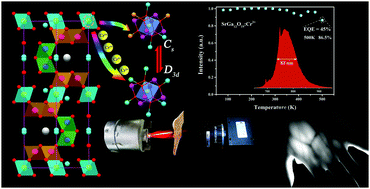
Efficient broadband near-infrared (NIR) light sources are urgently needed for emerging applications in medicine, food analysis, and others. Nevertheless, the performance is limited by luminescence efficiency and thermostability in state-of-the-art broadband NIR phosphors. Here we demonstrate an effective strategy for achieving efficient and thermostable broadband NIR emission by site engineering in a SrGa12O19–LaMgGa11O19:Cr3+ system. Due to the structure symmetry promotion, the end-member SrGa12O19:Cr3+ shows excellent luminescence thermostability, i.e., higher luminescence quenching temperature and more remarkable color stability compared with LaMgGa11O19:Cr3+. At 500 K, the integrated PL intensity remains 86.5% of that at 290 K. Fine local structure, photoluminescence spectra and luminescence decay curves together support that the optically activated Cr3+ centers are reduced due to site symmetry change in SrGa12O19:Cr3+, leading to the remarkable luminescence thermostability. Finally, we have fabricated NIR pc-LEDs with commercial blue-light-emitting InGaN chips (450 nm), showing that SrGa12O19:Cr3+ has a high external quantum efficiency of 45% and has great potential in high-power and efficient pc-LED applications.

Structural Confinement for Cr3+ Activators toward Efficient Near- Infrared Phosphors with Suppressed Concentration Quenching

Trivalent chromium ion-doped near-infrared (NIR) phosphors have been widely studied due to their tunable emission wavelengths and broad applications. High Cr3+ concentration can improve absorption efficiency but generally results in low emission intensity due to the concentration quenching effect. Herein, we report a series of efficient NIR phosphors with suppressed concentration quenching, Sr9M1–x(PO4)7:xCr3+ (M = Ga, Sc, In, and Lu), showing a broadband NIR emission ranging from 700 to 1100 nm peaking at 850 nm upon the 485 nm light excitation. The emission peak position is almost independent of the type of M ion and the Cr3+ dopant content, and the type of M ion has little influence on the luminescence thermal quenching, indicating that [MO6] octahedra are rigid enough to keep octahedral volumes and average M3+–O2– distances nearly constant owing to the formation of the framework structure on Cr3+ substitution. The NIR emission intensities monotonously increase with the Cr3+ content increasing from 0 to 80% with suppressed concentration quenching, the intensity of Sr9Cr(PO4)7 still maintains 84.23% of Sr9Ga0.2(PO4)7:0.8Cr3+ phosphor, and the thermal quenching behavior is slightly dependent on x; these effects can be attributed to the suppressed energy transfer due to the structural confinement effect. The optimal sample, Sr9Ga0.2(PO4)7:0.8Cr3+, has an internal/external quantum efficiency of 66.3%/29.9%. Finally, we fabricate a NIR phosphor-conversion light-emitting diode and demonstrate its applications in nondestructive examination and medical fields.

Tuning luminescence from NIR-I to NIR-II in Cr3+-doped olivine phosphors for nondestructive analysis

Journal of Materials Chemistry C .Issue 16, 2021

Graphical abstract: Tuning luminescence from NIR-I to NIR-II in Cr3+-doped olivine phosphors for nondestructive analysis

The practical application of near-infrared (NIR) phosphors is hindered due to their limited light emitting region and narrow bandwidth. Here, we report a series of Cr3+-doped olivine phosphors, (Mg1−xLix)(Mg1−xScx)GeO4:Cr3+, with tunable luminescence from NIR-I to NIR II based on crystallographic site engineering. By using a [Li+–Sc3+] unit substituting for a [Mg2+–Mg2+] unit, the NIR luminescence can be largely tuned from 940 nm to 1110 nm, and the corresponding FWHM can be modified from 236 to ∼300 nm. The internal quantum efficiency (IQE) and external quantum efficiency (EQE) of Mg2GeO4:1% Cr3+ were measured to be 48.19% and 16.38%, respectively. The photoluminescence of the phosphors matches well with the absorption of several functional groups. By measuring the NIR absorption of different liquids illuminated by NIR light from our phosphors, qualitative and quantitative analysis can be realized. These results suggest that the super-broad NIR luminescence of (Mg1−xLix)(Mg1−xScx)GeO4:Cr3+ has potential applications as light sources for nondestructive food analysis.


The red persistent luminescence of (Sr,Ca)AlSiN3:Eu2+ and mechanism different to SrAl2O4:Eu2+,Dy3+

Journal of Luminescence, April 2019, 208

(Sr,Ca)AlSiN3:Eu²⁺ phosphors have been widely used in phosphor-converted white light emitting diodes. Herein, we reported the strong red persistent luminescence in (Sr,Ca)AlSiN3:Eu²⁺ under UV light excitation. The Sr0.8Ca0.2AlSiN3:0.15% Eu²⁺ shows the strongest red persistent luminescence with a peak emission wavelength at ~628 nm and a persistent time of ~9600 s at the 0.32 mcd/m² threshold value. A new persistent luminescence mechanism, which is different to that of SrAl2O4:Eu²⁺,Dy³⁺, was proposed by comparing the thermoluminescence excitation spectrum (TLES) and the photoluminescence excitation spectrum (PLES) of Sr0.8Ca0.2AlSiN3:0.15% Eu²⁺. The electrons are directly excited from 4f ground states to the conduction band or from valence band to conduction band in (Sr,Ca)AlSiN3:Eu²⁺; while, in SrAl2O4:Eu²⁺,Dy³⁺, they are first excited to 5d level and then stimulated thermal process to the conduction band. The effect of Eu²⁺ concentration on red persistent luminescence in (Sr,Ca)AlSiN3:Eu²⁺ were discussed. The proposed mechanism of persistent luminescence can help us to design and find new persistent luminescence materials .

Enhanced Persistence Properties through Modifying the Trap Depth and Density in Y3Al2Ga3O12:Ce3+,Yb3+ Phosphor by Co-doping B3+

Journal of Alloys and Compounds, Volume 770, 5 January 2019, Pages 1069-1077

To fabricate white-light-emitting diodes (white LEDs) with high color-rendering index or full light spectrum emission, the discovery of more efficient deep-red emitting phosphor materials is essential. In this paper, we have synthesized a series of Sr2-2xEu2xSi5N8 (0 ≤ x ≤ 1) solid-solution compounds, and have systemically investigated effects of full-range Eu concentration on their luminescence. Their emission band maximum can be largely tuned from 610 to 725 nm by increasing Eu content. Reabsorption at low Eu2+ concentration while both the energy transfer and Stocks shift at high Eu2+ concentration account for this large spectral red-shift. Luminescent thermal quenching performance gets worse with Eu2+ concentration increasing. The compound with x = 0.15 possesses the best crystallinity and the highest luminescence intensity with the peak position around 660 nm, and still maintains 88.5% room-temperature intensity at 400 K, indicating that great potential for the application as a deep-red phosphor .

Effect of polyhedron deformation on the 5d energy level of Ce3+ in lanthanide aluminum perovskites

 Physical Chemistry Chemical Physics, January 2019, 21(5)

Graphical abstract: Effect of polyhedron deformation on the 5d energy level of Ce3+ in lanthanide aluminum perovskites

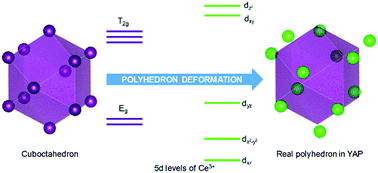
The crystal-field levels of Ce3+ in a series of lanthanide aluminum perovskites have been investigated with reference to polyhedron deformation. For each compound, the corresponding ideal cuboctahedron is derived through a least-square procedure. The virtual energy levels of Ce3+ in these ideal polyhedrons are then obtained considering both crystal-field splitting and spin–orbit coupling. From comparison to real levels, we have a clear understanding of how polyhedron deformation affects the energy levels of Ce3+ in the perovskites .

Tuning of Photoluminescence and Local Structures of Substituted Cations in xSr2Ca(PO4)2–(1 – x)Ca10Li(PO4)7:Eu2+ Phosphors

Chem. Mater., 2017, 29, 3, 1430–1438. https://doi.org/10.1021/acs.chemmater.7b00006

Local structure modification in solid solution is an essential part of photoluminescence tuning of rare earth doped solid state phosphors. Herein we report a new solid solution phosphor of Eu2+-doped xSr2Ca(PO4)2–(1–x)Ca10Li(PO4)7 (0 ≤ x ≤ 1), which share the same β-Ca3(PO4)2 type structure in the full composition range. Depending on the x parameter variation in xSr2Ca(PO4)2–(1 – x)Ca10Li(PO4)7:Eu2+, the vacancies generated in the M(4) site enable the nonlinear variation of cell parameters and volume, and this increases the magnitude of M(4)O6 polyhedra distortion. The local structure modulation around the Eu2+ ions causes different luminescent behaviors of the two-peak emission and induces the photoluminescence tuning. The shift of the emission peaks in the solid solution phosphors with different compositions has been discussed. It remains invariable at x ≤ 0.5, but the red-shift is observed at x > 0.5 which is attributed to combined effect of the crystal field splitting, Stokes shift, and energy transfer between Eu2+ ions. The temperature-dependent luminescence measurements are also performed, and it is shown that the photoionization process is responsible for the quenching effect .