
Probing Eu2+ Luminescence from Different Crystallographic Sites in Ca10M(PO4)7:Eu2+ (M = Li, Na, and K) with β-Ca3(PO4)2-Type Structure

Chem. Mater., 2017, 29, 17, 7563–7570. https://doi.org/10.1021/acs.chemmater.7b02724

Eu2+ local environments in various crystallographic sites enable the different distributions of the emission and excitation energies and then realize the photoluminescence tuning of the Eu2+ doped solid state phosphors. Herein we report the Eu2+-doped Ca10M(PO4)7 (M = Li, Na, and K) phosphors with β-Ca3(PO4)2-type structure, in which there are five cation crystallographic sites, and the phosphors show a color tuning from bluish-violet to blue and yellow with the variation of M ions. The difference in decay rate monitored at selected wavelengths is related to multiple luminescent centers in Ca10M(PO4)7:Eu2+, and the occupied rates of Eu2+ in Ca(1), Ca(2), Ca(3), Na(4), and Ca(5) sites from Rietveld refinements using synchrotron power diffraction data confirm that Eu2+ enters into four cation sites except for Ca(5). Since the average bond lengths d(Ca–O) remain invariable in the Ca10M(PO4)7:Eu2+, the drastic changes of bond lengths d(M–O) and Eu2+ emission depending on the variation from Li to Na and K can provide insight into the distribution of Eu2+ ions. It is found that the emission band at 410 nm is ascribed to the occupation of Eu2+ in the Ca(1), Ca(2), and Ca(3) sites with similar local environments, while the long-wavelength band (466 or 511 nm) is attributed to Eu2+ at the M(4) site (M = Na and K). We show that the crystal-site engineering approach discussed herein can be applied to probe the luminescence of the dopants and provide a new method for photoluminescence tuning .

Luminescence Tuning, Thermal Quenching, and Electronic Structure of Narrow-Band Red-Emitting Nitride Phosphors applications

Inorg. Chem., 2017, 56, 19, 11837–11844. https://doi.org/10.1021/acs.inorgchem.7b01816

Exploring high-performance narrow-band red-emitting phosphor is an important challenge for improving white light LEDs. Here, on the basis of three interesting nitride phosphors with similar vierer rings framework structure, two phosphor series, Eu2+-doped Sr(LiAl)1–xMg2xAl2N4 and Sr(LiAl3)1–y(Mg3Si)yN4 (x, y = 0–1), are successfully synthesized by a solid state reaction. They show narrow-band red emission with tunable emission peaks from 614 to 658 nm and 607 to 663 nm. The varying luminescence behaviors with composition and structure are discussed based on centroid shift, crystal field splitting and Stokes shift. On the basis of experimental data, we construct the host referred binding energy (HRBE) and vacuum referred binding energy (VRBE) schemes of divalent/trivalent lanthanide-doped end-member compounds, and further give thermal quenching mechanism of these series phosphors .

Ce3+-Doped garnet phosphors: composition modification, luminescence properties and applications

Chem. Soc. Rev., 2017,46, 275-299. https://doi.org/10.1039/C6CS00551A

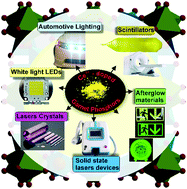
Garnets have the general formula of A3B2C3O12 and form a wide range of inorganic compounds, occurring both naturally (gemstones) and synthetically. Their physical and chemical properties are closely related to the structure and composition. In particular, Ce3+-doped garnet phosphors have a long history and are widely applied, ranging from flying spot cameras, lasers and phosphors in fluorescent tubes to more recent applications in white light LEDs, as afterglow materials and scintillators for medical imaging. Garnet phosphors are unique in their tunability of the luminescence properties through variations in the {A}, [B] and (C) cation sublattice. The flexibility in phosphor composition and the tunable luminescence properties rely on design and synthesis strategies for new garnet compositions with tailor-made luminescence properties. It is the aim of this review to discuss the variation in luminescence properties of Ce3+-doped garnet materials in relation to the applications. This review will provide insight into the relation between crystal chemistry and luminescence for the important class of Ce3+-doped garnet phosphors. It will summarize previous research on the structural design and optical properties of garnet phosphors and also discuss future research opportunities in this field .

After-glow, luminescent thermal quenching, and energy band structure of Ce-doped yttrium aluminum-gallium garnets

Journal of Luminescence, 2017,9, 192

Yttrium aluminum-gallium garnets with cerium doped is most widely used as green-yellow phosphor in solid state lighting. Extensive research has been performed on this material concerning the luminescent thermal quenching resistance and persistent luminescence. In this paper we find that a negative correlation exists between temperature-dependent luminescence and persistent luminescence with gallium content varying. The correlation originates from the electronic structures which influence both the thermal quenching of luminescence and persistent luminescence. A detailed crystal-field calculation has been performed to understand the peak shifts. In addition, theoretical calculations reveal that oxygen vacancies provide trap levels which implement the persistent luminescence. This material could be used as potential blue-light excited persistent luminescent material, with the after-glow time up to about 1. h with only cerium as the dopant, which is expected to be prolonged by co-doping other elements. This work may be helpful in guiding the discovery of other after-glow materials .

Crystal Structure and Photoluminescence Evolution of La5(Si2+xB1–x)(O13–xNx):Ce3+ Solid Solution Phosphors

J. Phys. Chem. C., 2015, 119, 17, 9488. https://pubs.acs.org/doi/10.1021/acs.jpcc.5b01211

A series of iso-structural La5(Si2+xB1–x)(O13–xNx):Ce3+ phosphors with apatite structure have been prepared. A combination of powder X-ray diffraction and neutron scattering technique was employed to explore the crystal structural evolution and the rigid nature from oxy- to oxynitride-based apatites, and some local structures were also characterized by HRTEM and 29Si NMR data, respectively. The new La5(Si2+xB1–x)(O13–xNx):Ce3+ solid solution phosphors gave continuously controlled emission from 421 nm [La5Si2BO13:Ce3+, end-member (x = 0)] to 463 nm (La5Si3O12N:Ce3+, end-member (x = 1)). Substitution of B3+ and O2– by Si4+ and N3– in La5(Si2+xB1–x)(O13–xNx):Ce3+ phosphors produced more covalency into the crystal field environment around the Ce3+ ions inducing the red-shifted emission, further improving the thermal stability of the oxynitride-based apatite phosphors. The proposed approach from oxy- to oxynitride based iso-structural phases could significantly contribute to future research in designing complex solid solution phosphors .

Complementary method to locate atomic coordinates by combined searching method of structure-sensitive indexes based on bond valence method

Chin. Phys. B., 2015, 24, 106101. https://iopscience.iop.org/article/10.1088/1674-1056/24/10/106101

Bond valence method illustrates the relation between valence and length of a particular bond type. This theory has been used to predict structure information, but the effect is very limited. In this paper, two indexes, i.e., global instability index (GII) and bond strain index (BSI), are adopted as a judgment of a search-match program for prediction. The results show that with GII and BSI combined as judgment, the predicted atom positions are very close to real ones. The mechanism and validity of this searching program are also discussed. The GII & BSI distribution contour map reveals that the predicted function is a reflection of exponential feature of bond valence formula. This combined searching method may be integrated with other structure-determination method, and may be helpful in refining and testifying light atom positions .

Chemical Unit Cosubstitution and Tuning of Photoluminescence in the Ca2(Al1–xMgx)(Al1–xSi1+x)O7:Eu2+ Phosphor

J. Am. Chem. Soc., 2015, 137, 39, 12494. https://pubs.acs.org/doi/10.1021/jacs.5b08315.

The union of structural and spectroscopic modeling can accelerate the discovery and improvement of phosphor materials if guided by an appropriate principle. Herein, we describe the concept of “chemical unit cosubstitution” as one such potential design scheme. We corroborate this strategy experimentally and computationally by applying it to the Ca2(Al1–xMgx)(Al1–xSi1+x)O7:Eu2+ solid solution phosphor. The cosubstitution is shown to be restricted to tetrahedral sites, which enables the tuning of luminescent properties. The emission peaks shift from 513 to 538 nm with a decreasing Stokes shift, which has been simulated by a crystal-field model. The correlation between the 5d crystal-field splitting of Eu2+ ions and the local geometry structure of the substituted sites is also revealed. Moreover, an energy decrease of the electron–phonon coupling effect is explained on the basis of the configurational coordinate model .
 

Synthesis, structure and tunable red emissions of Ca(Al/Si)2N2(N1−xOx):Eu2+prepared by alloy-nitridation method

J. Lumin., 2013, 137, 173. https://doi.org/10.1016/j.jlumin.2012.12.053

 A series of phosphors, Eu-doped Ca(Al/Si)2N2(N1−xOx), derivatives of CaAlSiN3, were synthesized by alloy-nitridation method. We demonstrated that their emission peaks can be tuned from 650 nm to 610 nm by oxygen preferential substitutions of nitrogen located at one of two crystallographic sites. Two luminescent centers corresponding to two types of Eu2+-coordination modes, i.e. EuNI2NII3 and EuNI2NII2O, were identified and accounted for the emission band structures, emission band shifts with oxygen/nitrogen substitutions, and the dependence of peak position and integrated emission intensity on temperature. As a typical example, Ca(Al/Si)2N2(N0.80O0.20):0.02Eu showed intense orange–red emission peaking at 622 nm and kept the feature of excellent chemical stabilities, which would have potential applications in fabricating the white light-emitting diode. The excellent luminescent properties of these materials, such as wavelength-tunable red emission and excellent chemical stabilities, make them practical for use in typical LED package .

Synthesis of YAG phosphor particles with excellent morphology by solid state reaction

J. Cryst. Growth., 2013, 365, 24. https://doi.org/10.1016/j.jcrysgro.2012.12.022

Cerium doped yttrium aluminum garnet (YAG:Ce) has been chosen as WLED phosphors for its appropriate spectral property. However, YAG powders synthesized by several methods do not satisfy commercial requirements in mobility, size distribution, luminescent intensity, etc. With flux added in the synthesis, well-shaped crystallites can nucleate and grow in the wetted micro domains. High temperature compensates the adverse effect of intermediate product on particle size. The final products are phosphor powders composed of uniformly distributed large particles. Preferred orientation in the XRD patterns confirms that the isolated particles are single crystals other than agglomeration of fine grains. This kind of phosphors has a better performance in WLED devices. This work will improve the commercial production of WLED phosphors .

Crystal structure and photoluminescence of (Y1−xCex)2Si3O3N4

J. Lumin., 2011, 131, 2, 336. https://doi.org/10.1016/j.jlumin.2010.10.032

Oxonitridosilicate phosphors with compositions of (Y1−xCex)2Si3O3N4 (x=0−0.2) have been synthesized by solid state reaction method. The structures and photoluminescence properties have been investigated. Ce3+ ions have substituted for Y3+ ions in the lattice. The emission and excitation spectra of these phosphors show the characteristic photoluminescence spectra of Ce3+ ions. Based on the analyses of the diffuse reflection spectra and the PL spectra, a systematic energy diagram of Ce3+ ion in the forbidden band of sample with x=0.02 is given. The best doping Ce content in these phosphors is ∼2 mol%. The quenching temperature is ∼405 K for the 2 mol% Ce content sample. The luminescence decay properties were investigated. The primary studies indicate that these phosphors are potential candidates for application in three-phosphor-converted white LEDs .