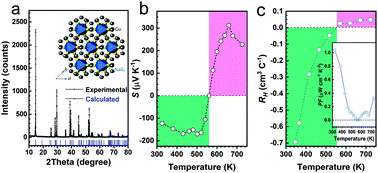
Temperature-driven n–p conduction type switching without structural transition in a Cu-rich chalcogenide, NaCu5S3


Chem. Commun.
, 2020,56, 4882-4885. https://doi.org/10.1039/D0CC01429J

We report for the first time the discovery of reversible n–p conduction type switching in a chalcogenide, NaCu5S3, without structural transition. AC impedance and first-principles simulations of the ionic migration confirmed the local melting trends of the hexagonal copper lattice at high temperatures, which could result in superionic conductivity within NaCu5S3.

Hybrid Metal Halides with Multiple Photoluminescence Centers

Angewandte Chemie., 2019, 58(51), 18670-18675. https://onlinelibrary.wiley.com/doi/abs/10.1002/anie.201911419

Very little is known about the realm of solid-state metal halide compounds comprising two or more halometalate anions. Such compounds would be of great interest if their optical and electronic properties could be rationally designed. Herein, we report a new example of metal halide cluster-assembled compound (C9NH20)9[Pb3Br11](MnBr4)2, featuring distinctly different anionic polyhedra, namely, a rare lead halide cluster [Pb3Br11]5− and [MnBr4]2−. In accordance with its multinary zero-dimensional (0D) structure, this compound is found to contain two distinct emission centers, 565 nm and 528 nm, resulting from the formation of self-trapped excitons and 4T1–6A1 transition of Mn2+ ions, respectively. Based on the high durability of (C9NH20)9[Pb3Br11](MnBr4)2 upon light and heat, as well as high photoluminescence quantum yield (PLQY) of 49.8 % under 450 nm blue light excitation, white light-emitting diodes (WLEDs) are fabricated, showcasing its potential in backlight application.

Single‐Component White‐Light Emission in 2D Hybrid Perovskites with Hybridized Halogen Atoms

Adv. Opt. Mater., 2019, 7(24), 1901335. https://onlinelibrary.wiley.com/doi/abs/10.1002/adom.201901335

With single-component photoinduced white-light (WL) emission, low-dimensional hybrid halide perovskites have emerged as a new generation of luminescent materials; however, the effect of halogens on the intrinsic light emissions and the corresponding mechanisms is still unknown. Herein, the investigation of a family of two-dimensional (2D) hybrid perovskites R2PbBr4−xClx (R = BA+, PMA+, PEA+; x = 0, 1, 2, 3, 4) highlights the influence of halogens on intrinsic emission to reveal the dependence of the photoluminescence on the nature and contribution of the halogens. Ultrabroad emissions covering the entire visible-light region are achieved in the halogen hybrid systems with the stoichiometry of R2PbBr2Cl2 (R = BA+, PMA+, PEA+), showing their potential as single-component WL phosphors in solid-state lighting devices. The origin of the WL emissions is the synergistic recombination emission of free excitons and self-trapped excitons. The ratio of halogens (Br/Cl) is confirmed to be a critical factor to fine-tune the intrinsic emission properties. This work provides a feasible strategy to achieve single-component WL emission in 2D hybrid perovskites, and proposes a method for regulating halogen contents for optimizing luminescent properties.

Crystal structure and luminescence properties of lead-free metal halides (C6H5CH2NH3)3MBr6 (M = Bi and Sb)


J. Mater. Chem. C, 2020,8, 7322-7329. https://doi.org/10.1039/D0TC00562B

Organic–inorganic hybrid metal halides have received extensive attention owing to their versatile structures and optoelectronic properties. Herein, we report two lead-free metal halides, (PMA)3BiBr6 and (PMA)3SbBr6 [PMA+: (C6H5CH2NH3)+, as the abbreviation of phenylmethylammonium], which possess iso-structural zero-dimensional structures and crystallize in the monoclinic space group P21/c. (PMA)3BiBr6 and (PMA)3SbBr6 exhibit optical band gaps of ∼3.50 and 3.40 eV, respectively, and density functional theory calculations reveal their indirect bandgap behaviors. Upon 350 and 425 nm excitation, (PMA)3BiBr6 and (PMA)3SbBr6 exhibit broadband emission peaking at 510 nm and 625 nm with wide full-widths at half-maximum of ∼153 and 175 nm, respectively. The emission mechanism of the metal halides is attributed to self-trapped exciton emission. The relationship between the crystal structure and luminescence intensity is also discussed. Finally, both metal halides have high decomposition temperatures and are stable for long-term storage under ambient conditions, demonstrating their potential for optoelectronic applications.

Sb3+ Doping-Induced Triplet Self-Trapped Excitons Emission in Lead-Free Cs2SnCl6 Nanocrystals

J. Phys. Chem. Lett., 2019, 10, 23, 7439–7444 https://pubs.acs.org/doi/abs/10.1021/acs.jpclett.9b03035

Doped halide perovskite nanocrystals (NCs) have opened new opportunities for the emerging optical and optoelectronic applications. Here, we describe a hot-injection synthesis of all-inorganic lead-free Cs2SnCl6 and Sb3+ doped Cs2SnCl6 NCs. Cs2SnCl6 NCs present a blue emission peak at 438 nm, whereas a new broad-band emission peak appears at 615 nm for the Sb3+ doped NCs. Comparative structural and spectral characterizations of Sb3+ doped Cs2SnCl6 NCs with micrometer-sized undoped and Sb3+ doped crystals show that the formation of broad-band orange emission is originted from triplet self-trapped excitons, attributed to the 3Pn–1S0 transitions (n = 0, 1, 2). Our results in Sb3+ doped Cs2SnCl6 materials provide insights into the machanisms of doping-induced emission centers, and it extends the existing knowledge of optical properties of doped halide NCs for further studies.

Lead-Free Hybrid Metal Halides with a Green-Emissive [MnBr4] Unit as a Selective Turn-On Fluorescent Sensor for Acetone

Inorg. Chem. 2019, 58, 19, 13464–13470.https://pubs.acs.org/doi/abs/10.1021/acs.inorgchem.9b02374

Abstract Image

Organic–inorganic hybrid metal halides with zero-dimensional (0D) structure has emerged as a new class of light-emitting materials. Herein, a new lead-free compound (C9NH20)2MnBr4 has been discovered and a temperature-dependent phase transition has been identified for two phases (space group P21/c and C2/c) in which individual [MnBr4]2– anions connect with organic cations, (C9NH20+) (1-buty-1-methylpyrrolidinium+), forming periodic structure with 0D blocks. A green emission band, peaking at 528 nm with a high photoluminescence quantum efficiency (PLQE) of 81.08%, has been observed at room temperature, which is originated from the 4T1(G) to 6A1 transition of tetrahedrally coordinated Mn2+ ions, as also elaborated by density functional theory calculation. Accordingly, a fast, switchable, and highly selective fluorescent sensor platform for different organic solvents based on the luminescence of (C9NH20)2MnBr4 has been developed. We believe that the hybrid metal halides with high PLQE and the exploration of these as a fluorescence sensor will expand the applications scope of bulk 0D materials for future development.

Optically Modulated Ultra-Broad-Band Warm White Emission in Mn2+-Doped (C6H18N2O2)PbBr4 Hybrid Metal Halide Phosphor

Chem. Mater., 2019, 31, 15, 5788–5795. https://pubs.acs.org/doi/abs/10.1021/acs.chemmater.9b01864

Finding new low-dimensional metal halides with broad-band emission is attracting interest in single-component phosphor for white light-emitting diodes (WLEDs). The full-spectrum white light still remains a challenge as found in the two-dimensional hybrid material (C6H18N2O2)PbBr4 exhibiting the intrinsic free exciton (FE) and broad-band self-trap exciton (STE) emission upon 365 nm ultraviolet excitation, and a combined strategy has been proposed through doping the Mn2+ ions enabling a superposition of multiple emission centers toward the ultra-broad-band warm white light. The occupation of Mn2+ in (C6H18N2O2)PbBr4 has been discussed, and optical investigations verify that the warm white-light emission of Mn2+-doped (C6H18N2O2)PbBr4 originates from the coupling effects of the FE, STEs, and the 4T1–6A1 transition of the doped Mn2+. When the concentration of Mn2+ is 5%, the emission spectrum of the phosphor covers all visible-light areas with a full width at half maximum (FWHM) of about 230 nm. The high Ra (84.9) and warm light CCT (3577 K) values of the as-fabricated WLED lamp demonstrate that (C6H18N2O2)Pb1–xMnxBr4 can be promising as single-component white-light phosphor in solid-state lighting. Our work could provide a new understanding and perspective about hybrid metal halides for designing superior phosphor toward single-component white emission.

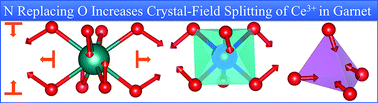
Effect of nitrogen substitution on luminescence tuning in garnets

Phys. Chem. Chem. Phys., 2020,22, 9513-9517. https://doi.org/10.1039/D0CP00586J

Anionic substitution is attracting research interest as a property modulation strategy. Although the effect of nitrogen incorporation on luminescence tuning has been widely reported, the correlation between dodecahedral expansion on Si4+–N3− co-substitution and crystal-field splitting of Ce3+ in garnets is rarely discussed. This work is devoted to unraveling the structure–property relationship between anionic substitution and spectroscopy tuning. Ligand movement patterns of a dodecahedron and an octahedron are investigated for tetragonal distortion and inter-facial distance, both of which indicate an energy level shift originating from the crystal-field effect. The quantitative crystal-field calculation is performed on the basis of ligand coordinates to derive the analytical expression for further confirmation. This work complements the substitution effects of both cationic and anionic chemical species on spectral tuning in garnets, and will be helpful in material design and property modulation of garnet-based luminescent materials.

Tuning of the Compositions and Multiple Activator Sites toward Single-Phased White Emission in (Ca9–xSrx)MgK(PO4)7:Eu2+ Phosphors for Solid-State Lighting

Inorg. Chem. 2019, 58, 8, 5006–5012 https://pubs.acs.org/doi/abs/10.1021/acs.inorgchem.9b00028

Manipulating the distribution of rare earth activators in multiple cations’ sites of phosphor materials is an essential step to obtain tunable emission for the phosphor-converted white-light-emitting diodes (pc-WLEDs). However, it remains the challenge to realize the photoluminescence tuning in the single-phased phosphor with single activator, due to the uncertain location of doped ions and adjustable crystallographic sites. Herein we reported the β-Ca3(PO4)2-type solid solution phosphors (Ca8.98–xSrx)MgK(PO4)7:2%Eu2+ (x = 0–8.98) and the effects of replacing Ca2+ by Sr2+ ions on the phase structures and color-tunable emission were investigated in detail. Tunable color emission has been realized by manipulating the redistribution of Eu2+ ions among different cation sites with adjustable chemical environment, and the related mechanism on the local structures has been discussed. The high Ra (85) and low color temperature (CCT) (4465 K) values of the as-fabricated WLEDs lamp indicate that (Ca4.98Sr4)MgK(PO4)7:2%Eu2+ can act as a promising white-emitting phosphor for single-phased pc-WLEDs. This work provides a new insight into the tuning of the compositions and multiple activator sites toward single-phased white emission.

Broad-Band Emission in a Zero-Dimensional Hybrid Organic [PbBr6] Trimer with Intrinsic Vacancies

J. Phys. Chem. Lett. 2019, 10, 6, 1337–1341 https://pubs.acs.org/doi/abs/10.1021/acs.jpclett.9b00238

The understanding of broad-band emission mechanisms on low-dimensional metal halides is an urgent need for the design principle of these materials and their photoluminescence tuning. Herein, a new zero-dimensional (0D) organic–inorganic hybrid material (C9NH20)6Pb3Br12 has been discovered, in which face-sharing PbBr6 trimer clusters crystallize with organic cations (C9NH20+), forming periodic structure with 0D blocks. Broad-band green emission peaking at about 522 nm was observed for this material, with a full width at half-maximum (fwhm) of 134 nm. The emission was attributed to excitons trapped at controlled intrinsic vacancies, and this is the new example in 0D metal halides, also confirmed by spectroscopy analysis and first-principles calculations. Discovery of the single-crystalline hybrid material and observation of defect-induced luminescence extend the scope of bulk 0D materials and understanding of photophysical properties for optoelectronic applications.