A review on the Eu2+ doped β-Ca3 (PO4) 2-type phosphors and the sites occupancy for photoluminescence tuning

Opt. Mater.X., 2019, 1. https://www.sciencedirect.com/science/article/pii/S2590147819300099

β-Ca3(PO4)2-type phosphors have received much attention due to their ability for heterovalent substitution of Ca2+ by different cations to form the new phases, and their abundant crystallographic sites for the doped activator, such as Eu2+, to tune the photoluminescence. Thus, these phosphors have great potential on the applications in white light-emitting diodes (WLEDs) for their tunable emission. Accordingly, there is increasing interest in the discovery of new β-Ca3(PO4)2-type phosphors for WLEDs and the deep understanding on the mechanisms responsible for occupation by Eu2+ ions of particular sites in the host lattice, so that the modulation of emission color and intensity can be controlled. In this review, we summarized the structural construction of β-Ca3(PO4)2-type compounds based on such a mineral-inspired prototype evolution perspective. Then we reviewed the recent research on the luminescence properties and sites occupancy of Eu2+ ions in different β-Ca3(PO4)2-type phosphors. Finally, combining with the current advances, we proposed the research prospects and future work of β-Ca3(PO4)2-type phosphors.
Understanding the abnormal lack of spectral shift with cation substitution in highly efficient phosphor La3Si6N11:Ce3+

Phys. Chem. Chem. Phys., 2020,22, 14162-14168. https://doi.org/10.1039/D0CP01445A

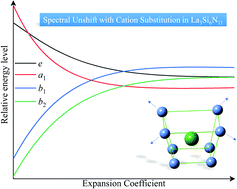
Cation substitution is a common strategy to tune the luminescence by modulating the cell parameter, polyhedral volume and bond length in solid-solution-type phosphors. Generally a close correlation between their cationic composition and spectral peak shifts can be observed. In certain compounds, however, luminescence tuning by cationic modification is almost invalid. This work is devoted to providing a reasonable explanation for the anomaly in Ce3+ doped La3Si6N11, which demonstrates unshifted excitation peaks with various cation substitutions. By simplifying the local coordination polyhedron that accommodates Ce3+ to a truncated square pyramid model, the quantitative crystal-field calculations are conducted to demonstrate the influences of the coordination environment on energy levels. The results show that the crystal-field levels become insensitive to this special type of ligand environment, leading to imperceptible peak shifts. Therefore, the relationship between the cationic composition and luminescence is determined not only by the ionic radii but also by the type of coordination polyhedron. This work shows that studying the coordination environment is helpful for achieving effective luminescence tuning.

Broadband Photoluminescence in 2D Organic–Inorganic Hybrid Perovskites: (C7H18N2)PbBr4 and (C9H22N2)PbBr4

J. Phys. Chem. Lett. 2020, 11, 8, 2934–2940. https://pubs.acs.org/doi/10.1021/acs.jpclett.0c00578.

Organic–inorganic hybrid perovskites have aroused intense research interest because of their excellent physical performance and potential for use in optoelectronic field. Herein, we report two new 2D hybrid lead bromides, (C7H18N2)PbBr4 [C7H18N2 is 1,7-diaminoheptane] and (C9H22N2)PbBr4 [C9H22N2 is 1,9-diaminononane], both of which possess ⟨100⟩-oriented inorganic layers consisting of corner-sharing octahedra. The optical bandgaps are experimentally determined to be 2.76 eV for (C7H18N2)PbBr4 and 2.78 eV for (C9H22N2)PbBr4. Upon 390 nm excitation, (C7H18N2)PbBr4 exhibits white-light emission centered at 600 nm, and (C9H22N2)PbBr4 exhibits red-light emission centered at 620 nm. These broad photoluminescent spectra originate from the synergistic emission of free excitons (FEs) and self-trapped excitons (STEs). This work provides a strategy for realizing single-component white-light emission and efficient red-light emission in two-dimensional perovskites, demonstrating the vast application prospects of 2D perovskites in photoelectric devices.

Yellow persistent luminescence and electronic structure of Ca-α-Sialon: Eu2+

J. Alloys Compd., 2020, 821, 153482. https://doi.org/10.1016/j.jallcom.2019.153482

Ca-α-Sialon: Eu2+, a well-known yellow phosphor, has been widely studied due to its broad UV-blue excitation with high quantum efficiency. Herein, we report the yellow persistent luminescence (PersL) of a series of Ca-α-Sialon: Eu2+ compounds with chemical formula CaSi10-nAl2+nOnN16-n: xEu2+ (m = 2, n = 0∼1, x = 0.1%∼8%) prepared by high-temperature solid-state method. Upon 254 nm ultraviolet excitation, Ca-α-Sialon: Eu2+ shows yellow PersL, and the persistent time is strongly dependent on the Eu2+ and oxygen concentrations. The best persistent time is measured to be about 60 min for the CaSi10Al2N16: 0.5% Eu2+ sample. A very broad trap depth distribution, i.e. 0.6–1.4 eV, originating from two categories, are obtained by analyzing preheating thermoluminescence (TL) spectra using initial rise method. Comparing thermoluminescence excitation spectra (TLEs) with photoluminescence excitation spectra (PLEs), we verify that electrons as charge carriers are excited from 4f ground state of Eu2+ to conduction band (CB) directly in the charging process for PersL. By functional theory (DFT) calculations, we verify that the trap levels responsible for PersL are impurity defects including VO and VN in Ca-α-Sialon. Furthermore, the PersL mechanism is given on the basis of constructing the host referred binding energy (HRBE) diagram. By virtue of NIR photo-stimulating PersL spectrum, we demonstrate that Ca-α-Sialon has a potential application in anti-counterfeit and information storage. This work would encourage more exploration of Eu2+-doped nitride phosphor for persistent or long-persistent luminescence.

Enhanced persistent luminescence via Si4+ co-doping in Y3Al2Ga3O12:Ce3+, Yb3+, B3+

J. Lumin., 2020, 222, 117190. https://doi.org/10.1016/j.jlumin.2020.117190.

Persistent luminescence phosphors with long duration and high emitting intensity have attracted considerable attention for applications in safety signage and energy storage. Herein, we successfully introduce non-equivalent ions Si4+ into Al3+ sites in the garnet phosphor Y3Al2Ga3O12:Ce3+,Yb3+,B3+ by conventional solid-state reaction. The persistent luminescence duration has been dramatically enhanced over 40 h at the 0.32 mcd/m2 threshold value after visible light radiation, almost twice longer than the sample without Si4+. Moreover, the afterglow emission intensity of the persistent luminescence is also improved. We confirm that the synthesized phosphors possess not only deeper trap depth but also wider trap distribution and higher trap density after the cooperation of Si4+. The initial rise approach is used by performing a series of thermoluminescence analyses at various temperatures after 432 nm excitation, which demonstrates the exact trap distribution from 0.47 to 1.11 eV. At the end, the mechanism of the persistent luminescence is depicted using a schematic energy diagram of the vacuum referred binding energy of Y3Al2Ga3O12.

Infrared-photostimulable and long-persistent ultraviolet-emitting phosphor LiLuGeO4:Bi3+,Yb3+ for biophotonic applications

Mater. Chem. Front., 2021,5, 1468-1476 https://pubs.rsc.org/en/content/articlelanding/2021/qm/d0qm00932f/unauth

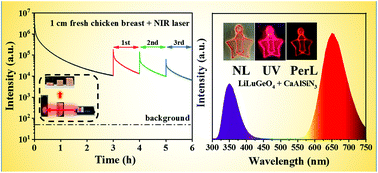
Photodynamic therapy needing ultraviolet (UV) in deep tissue is hindered due to the low biological tissue penetration ability of UV light. Here, we demonstrate a persistent ultraviolet-emitting phosphor, LiLuGeO4:Bi3+,Yb3+, which can be re-stimulated by near infrared (NIR) light. Yb3+-doping significantly enhances the trap density without changing the thermoluminescence peak positions. The phosphor can be effectively activated by a 254 nm lamp and exhibits prominent persistent luminescence peaking at 350 nm. The decay time can be recorded much longer than 15 h. This phosphor exhibits simulated in vivo photostimulated persistent luminescence after a longtime decay by using in vitro NIR light penetrating biological tissue. Combined with CaAlSiN3:Eu2+, red persistent luminescence from Eu2+ is obtained. LiLuGeO4:Bi3+,Yb3+ makes up the shortage of excellent UVA persistent phosphors. It is expected to have potential applications as an in vivo renewable excitation source to trigger photosensitizers or fluorescent probes when used for biophotonic applications.

Crystal-field splitting of Ce3+ in narrow-band phosphor SrLiAl3N4

J. Rare Earths., 2021, 39(4), 386-389https://www.sciencedirect.com/science/article/abs/pii/S1002072120300053

As a promising narrow-band phosphor, SrLiAl3N4 has a seemingly ultra-small total crystal-field splitting of only 2400 cm−1 with Ce3+ as dopant ions. This paper is devoted to unravel this anomalous phenomenon based on semi-quantitative crystal-field calculations. The results show that there may exist undetected excitation peaks immersed in the host excitation band, and the calibrated crystal-field splitting is 27000 cm−1, comparable to those of other Ce3+ doped phosphors. In the end the effect of polyhedral deformation on energy level is briefly discussed.

Efficiency-Tunable Single-Component White-Light Emission Realized in Hybrid Halides Through Metal Co-Occupation

ACS Appl. Mater. Interfaces 2021, 13, 25, 29835–29842 https://pubs.acs.org/doi/abs/10.1021/acsami.1c07636

Organic–inorganic hybrid metal halides have attracted widespread attention as emerging optoelectronic materials, especially in solid-state lighting, where they can be used as single-component white-light phosphors for white light-emitting diodes. Herein, we have successfully synthesized a zero-dimensional (0D) organic–inorganic hybrid mixed-metal halide (Bmpip)2PbxSn1–xBr4 (0 < x < 1, Bmpip+ = 1-butyl-1-methyl-piperidinium, C10H22N+) that crystallizes in a monoclinic system in the C2/c space group. Pb2+ and Sn2+ form a four-coordinate seesaw structure separated by organic cations forming a 0D structure. For different excitation wavelengths, (Bmpip)2PbxSn1–xBr4 (0 < x < 1) exhibits double-peaked emission at 470 and 670 nm. The emission color of (Bmpip)2PbxSn1–xBr4 can be easily tuned from orange-red to blue by adjusting the Pb/Sn molar ratio or excitation wavelength. Representatively, (Bmpip)2Pb0.16Sn0.84Br4 exhibits approximately white-light emission with high photoluminescence quantum yield up to 39%. Interestingly, the color of (Bmpip)2PbxSn1–xBr4 can also be easily tuned by temperature, promising its potential for application in temperature measurement and indication. Phosphor-converted light-emitting diodes are fabricated by combining (Bmpip)2PbxSn1–xBr4 and 365 nm near-UV LED chips and exhibit high-quality light output.

Lead-Free Broadband Orange-Emitting Zero-Dimensional Hybrid (PMA)3InBr6 with Direct Band Gap

Inorg. Chem., 2019, 58, 22, 15602–15609. https://pubs.acs.org/doi/abs/10.1021/acs.inorgchem.9b02669

Low-dimensional organic–inorganic hybrid metal halides have emerged as broadband light emitters for phosphor-converted white light-emitting diodes (WLEDs). Herein, we report a new zero-dimensional (0-D) lead-free metal halide (PMA)3InBr6 [PMA+: (C6H5CH2NH3)+] that crystallizes in the monoclinic system with P21/c space group. The structure consists of slightly distorted [InBr6]3– octahedra surrounded by organic PMA+ cations. The direct band gap characteristic of (PMA)3InBr6 was demonstrated by density functional theory calculation, and its relatively wide band gap of 3.78 eV was experimentally determined. Upon 365 nm ultraviolet light excitation, (PMA)3InBr6 exhibited strong broadband orange luminescence with a full-width at half-maximum of ∼132 nm resulting from self-trapped exciton emission, and the photoluminescence quantum yield was determined to be ∼35%. A WLED fabricated by combining the orange-emitting (PMA)3InBr6, a green phosphor Ba2SiO4:Eu2+, and a blue phosphor BaMgAl10O17:Eu2+ exhibited a high color-rendering index of 87.0. Our findings indicate that the organic–inorganic hybrid (PMA)3InBr6 may have potential for luminescence-based applications.

Luminescent thermal stability and electronic structure of narrow-band green-emitting Sr-Sialon: Eu2+ phosphors for LED/LCD backlights

J. Alloys Compd., 2019, 805, 1246-1253. https://www.sciencedirect.com/science/article/abs/pii/S092583881932715X

Stable and high-efficiency narrow-band green phosphor is a key component for wide color gamut liquid crystal display (LCD) backlights. In this paper, narrow-band green-emitting Sr3-3xSi13Al3O2N21:3xEu2+ (0.001 ≤ x ≤ 0.09) (Sr-Sialon:Eu2+) phosphor with a full-width at half maximum of 66 nm has been successfully synthesized by using the solid-state reaction method. All the samples are the pure phase with Sr3Si13Al3O2N21-type structure. Their emission band maximum can be tuned from 495 to 523 nm by increasing Eu2+ content. The compound with x = 0.03 possesses the highest luminescence intensity with the peak position around 510 nm. Luminescent thermal stability gets better with Eu2+ concentration decreasing. The integrated intensity of the sample with x = 0.01 at 425 K remains about 80% of the intensity at room temperature. The host referred binding energy (HRBE) and vacuum referred binding energy (VRBE) schemes are constructed to further explain its luminescent thermal quenching mechanism. White light-emitting-diode (w-LED) device using optimized Sr2.91Si13Al3O2N21:0.09Eu2+ phosphor demonstrates its potential application for LCD backlights.