
Crystal Growth & Design 24, (5), 2226-2234, 2024. https://doi.org/10.1021/acs.cgd.4c00055
Progress of Ce3+ /Eu2+ doped phosphors for violet chip based full-spectra lighting
Journal of Materials Chemistry C 12, (30), 11209-11241, 2024. https://doi.org/10.1039/D4TC02197E
NIR-II Luminescence With A Recorded 76% EQE Through Energy Extraction From Dark Cr3+
Laser & Photonics Reviews 18, (12), 2400475, 2024. https://doi.org/10.1002/lpor.202400475
Extending Near-Infrared Emission Beyond 900 nm in Cr3+-Activated Niobate Double Perovskites
ACS Applied Optical Materials 2, (5), 795-803, 2024. https://doi.org/10.1021/acsaom.4c00070
Advances in Fe3+-activated luminescent materials for near-infrared light sources
Progress in Solid State Chemistry 100456, 2024. https://doi.org/10.1016/j.progsolidstchem.2024.100456
Host Dependency of Boundary between Strong and Weak Crystal Field Strength of Cr3+ Luminescence
The Journal of Physical Chemistry Letters 15, (9), 2319-2324, 2024. https://doi.org/10.1021/acs.jpclett.4c00008
Electron Tunneling Charging upon Sunlight for Near-Infrared Persistent Luminescence
LASER & PHOTONICS REVIEWS.08 February 2023.https://doi.org/10.1002/lpor.202200999
For the conventional persistent luminescence (PersL) charging processes, carriers are photo-pumped to the conduction band (CB) or high-energy excited states (HES) under short-wavelength UV or coherent near-infrared (NIR) laser excitation. Herein, electron tunneling charging behavior is reported in Cr3+, Sm3+ co-doped NIR PersL magnetoplumbite SrGa12O19, which allows for efficient charging by incoherent visible light. First, the electrons are efficiently captured by the neighboring GaII-O2− electron–hole trap centers via a tunneling process, and then these excited electrons are transferred to shallow traps via a persistently energetic optical pump. This work further optimizes the PersL performance via engineering the energy band through partial substitution of In3+ for Ga3+. Consequently, tunneling charging occurring near the neighboring Cr3+-traps dimers enables Sr(Ga,In)12O19:Cr3+,Sm3+ to display brighter NIR PersL (≈760 nm, peak; ≈100 nm, FWHM) than gallate spinel under sunlight irradiation. This work provides insights into electron tunneling charging under low-energy excitation for NIR PersL, which may inspire more PersL explorations for practical applications.
Efficient Solar Spectrum-Like White-Light Emission in Zinc-Based Zero-Dimensional Hybrid Metal Halides
ADVANCED OPTICAL MATERIALS.27 April 2023.https://doi.org/10.1002/adom.202300218
Organic–inorganic metal halides (OIMHs) with high-efficiency solar spectrum-like emission are attracting broad and current interest. Here, five 0D Zn-based hybrid halides are synthesized based on aromatic organic cations with different carbon-chain lengths: C6H5CH2NH3+ (PMA+) and C6H5(CH2)4NH3+ (PBA+). (PMA)2ZnCl4 exhibits the highest photoluminescence quantum yield of 37.2% of reported Zn-based white-emission OIMHs. The emission spectrum of (PBA)2ZnI4 indicates a color rendering index of 98, which is the highest among single-component white-light-emitting phosphors. Spectral characterizations and density functional theory calculations demonstrate that the extremely broad emission of (PBA)2ZnI4 originates from the synergistic emission of organic cations and self-trapped excitons. The optical properties of the obtained (PMA)2ZnBr4, (PMA)2ZnI4·H2O, and (PBA)2ZnCl4 are also characterized for comparison, and with the same organic cations, the PLQY decreases from chloride to bromide to iodide. This work demonstrates that the selection of appropriate organics and halogens can enable fine tuning of single-component white-light emission, satisfying varying needs for solid-state lighting.
Small Organic Molecular-Based Hybrid Halides with High Photoluminescence Quenching Temperature
Inorg. Chem. 2022, 61, 19, 7560–7567.https://doi.org/10.1021/acs.inorgchem.2c00711

Organic–inorganic metal halides (OIMHs) exhibit excellent photoelectric properties; however, their high-temperature light-emission stability requires further improvement. Here, we report three isostructural OIMHs (C2H8N)4InCl7, (C2H8N)4SbCl7, and (C2H8N)4SbBr7 (C2H8N+ = dimethylammonium). They are all crystallized in the P21212 space group with a zero-dimensional (0D) structure, with orange-red photoluminescence (PL) under 365 nm UV excitation. Among them, (C2H8N)4InCl7 exhibits the strongest PL with a photoluminescence quantum yield (PLQY) of 13.9% at room temperature. Optical property measurements and density functional theory unveil that the luminescence of (C2H8N)4InCl7 at 405 and 620 nm is due to free exciton and self-trapped exciton emission, respectively. It is worth noting that (C2H8N)4InCl7 shows a high PL quenching temperature, maintaining 50% of its room-temperature PL intensity at 425 K, which is rare in OIHMs. This is much higher than the application temperature of phosphors in practical solid-state lighting applications (363–383 K). In this temperature range, the luminous intensity of (C2H8N)4InCl7 exceeds 60% of that at room temperature. The high PL quenching temperature observed in (C2H8N)4InCl7 indicates the potential of OIMHs for applications in phosphor-converted light-emitting diodes.
Antimony doping to enhance luminescence of tin(iv)-based hybrid metal halides
Inorg. Chem. Front., 2022,9, 3865-3873.https://doi.org/10.1039/D2QI00884J
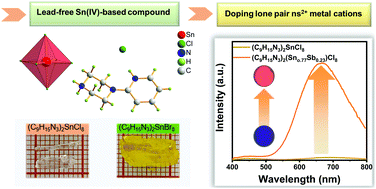
Lead-based organic–inorganic metal halides (OIMHs) have recently attracted special attention due to their efficient broadband photoluminescence. However, the toxicity of lead poses a challenge for their further development. Here, we selected Sn(IV) as the metal center to synthesize the environmentally friendly and stable luminescent OIMHs (C9H15N3)2SnCl8 and (C9H15N3)2SnBr8 (C9H13N3 is 1-(2-pyridyl)piperazine). Both compounds possess zero-dimensional structures, crystallizing in the monoclinic space group P21/c, and their optical band gaps were experimentally determined to be 3.19 and 2.60 eV, respectively. Under UV excitation at room temperature, (C9H15N3)2SnCl8 exhibited double-peak emissions centered at 405 and 688 nm, which were attributed to the organic cation and inorganic octahedra, respectively. Upon introducing 5s2-lone-pair-containing Sb3+ in (C9H15N3)2SnCl8, self-trapped emission was promoted, and the photoluminescence quantum yield increased from ∼1% to ∼17.84%. This work suggests effective strategies for finding environmentally friendly stable OIMHs and for further enhancing the luminescence properties through lone-pair-containing cation doping.
Copyright 2026.北京科技大学 光功能材料与器件实验室. All Rights Reserved.
