Synthetic-Method-Dependent Antimony Bromides and Their Photoluminescent Properties

Inorg. Chem. 2022, 61, 38, 15016–15022,https://doi.org/10.1021/acs.inorgchem.2c01900

Recently, excellent optical properties of low-dimensional organic–inorganic metal halides, stemming from their tunable structure and optoelectronic properties, have been demonstrated. The synthetic method is critical because it is highly related to the structure and properties of the halide. Herein, we obtain two different antimony bromides, (Bmpip)2SbBr5 and (Bmpip)3Sb2Br9, which both possess the P21/c space group having different crystal structures, and this confirms the important influence of synthesis on the single-crystal structure. (Bmpip)2SbBr5 contains Bmpip+ and [SbBr5]2– pyramids, and (Bmpip)3Sb2Br9 consists of Bmpip+ and Sb-based dimers [Sb2Br9]3–. Under 400 nm excitation, (Bmpip)2SbBr5 exhibits a 640 nm orange emission with a quantum yield of ∼11.5% owing to Sb 5s2 electron luminescence. A diode was fabricated by (Bmpip)2SbBr5 and commercial phosphors and showed a high color render index of 92. Our work reveals the effect of the preparation method on the crystal structure. A luminescent material was finally identified.

Photoluminescent Properties of Two-Dimensional Manganese(II)- Based Perovskites with Different-Length Arylamine Cations

Inorg. Chem. 2022, 61, 30, 11973–11980.https://doi.org/10.1021/acs.inorgchem.2c01730

The participation of organic cations plays an important role in tuning broad-spectra emissions. Herein, we synthesized a series of Mn(II)-based two-dimensional (2D) halide perovskites with arylamine cations of different lengths having the general formula (C6H5(CH2)xNH3)2MnCl4 (x = 1–4), with the x = 4 compound reported here for the first time. With the increase in the −(CH2)– in organic cations, the distance between adjacent inorganic layers increases, causing the title compounds to exhibit different structural distortions. As the Mn–Cl–Mn angular distortion increases, the experimental optical band gaps of the title compounds increase correspondingly. When the angle distortion between the octahedrons of the compounds is similar, the band gaps may also be affected by the distortion of the octahedron itself (the bond-length distortion of 2 is greater than that of 4). Under UV-light irradiation at 298 K, all of the compounds exhibit two emission peaks centered at 480–505 and 610 nm, corresponding to the organic-cation emission and the 4T1(G) to 6A1(S) radiative transition of Mn2+ ions, respectively. Among these title compounds, (PPA)2MnCl4 [(PPA)+ = C6H5(CH2)3NH3+] exhibits the strongest photoluminescence (PL). The study of the title compounds contributes to an in-depth understanding of the relationship between the structural distortion and optical properties of 2D Mn(II)-based perovskite materials.

Near-Infrared Mechanoluminescence of Cr3+ Doped Gallate Spinel and Magnetoplumbite Smart Materials

Advanced Functional Materials, 2023, 01, https://doi.org/10.1002/adfm.202209275

Mechanoluminescence (ML), as an optical response to deformation stimuli, shows great potential in high-end stress sensing, ultrasonic field visualization, and multidimensional anti-counterfeiting. However, processive practical applications in bio-medicine are constrained by the discovery of near-infrared (NIR) ML materials. Unlike lanthanides (Ln3+) with sharp multiplets, two kinds of Cr3+-doped NIR ML materials, gallate spinel (ZnGa2O4:Cr3+, Zn3Ga2GeO8:Cr3+) and gallate magnetoplumbite (SrGa12O19:Cr3+) are here reported. Owing to the intrinsic cation antisite defects and cation vacancies in the matrix, these materials exhibit bright NIR ML under a relatively low load (20 N). In particular for SrGa12O19:Cr3+ (750 nm, peak; 100 nm, FWHM) with low persistent luminescence (PersL) interference, the ML behavior can be further rejuvenated under UV and sunlight irradiation. SrGa12O19:Cr3+ also shows bright NIR emission under photo- and thermo-stimulation. Owing to their excellent tissue penetration and concealment capability, NIR ML materials show great potential in the fields of bio-medicine and anti-counterfeiting.

High-Efficiency Intrinsic Yellow-Orange Emission in Hybrid Indium Bromide with Double Octahedral Configuration

Inorg. Chem. 2023, 02, 07, 3018–3025, https://doi.org/10.1021/acs.inorgchem.2c03653

Zero-dimensional (0D) In-based organic–inorganic metal halides (OIMHs) have received growing interest in recent years as promising luminescent materials. However, the high efficiencies of 0D In-based OIMHs are all dependent on Sb doping in the existing literature. Here, we report a novel 0D In-based OIMH (C10H22N2)2In2Br10, which exhibits intrinsic broadband emission (610 nm), and the photoluminescence quantum yield (PLQY) can reach 70% without Sb doping. (C10H22N2)2In2Br10 shows a typical 0D structure with three different In–Br polyhedra (two octahedra and one tetrahedron) separated by large organic cations. Based on the optical property measurements and theoretical calculations, we demonstrate that (C10H22N2)2In2Br10 is an indirect semiconductor with a band gap of 3.74 eV, and the In–Br inorganic moiety is primarily responsible for the intense emission of (C10H22N2)2In2Br10. Interestingly, the unique double octahedral configuration in (C10H22N2)2In2Br10 may enhance the structural distortion and stimulate the self-trapped excitons (STEs), leading to the related high PLQY. Our work provides a novel 0D In-based OIMH with high-efficiency intrinsic emission, which is helpful for understanding the structure–PL relationships of hybrid halides.

BFIP: an online tool to calculate the best fitted idealized polyhedron

J. Appl. Cryst. (2023). 56, 884-888, https://doi.org/10.1107/S160057672300328X

Polyhedron ligands have been frequently used to characterize the ligand environment in inorganic materials. With a cation or anion as the central atom, its bonded counterparts are set as the vertices of the polyhedron. Generally, a series of geometrical parameters of the polyhedron, such as the average bond length and volumetric size, are extracted to illustrate the subtle change of local structure on compositional substitution. Polyhedral distortion analysis is widely adopted in research fields relying on a strong structure–property relationship. For example, in rare-earth or transition-metal element doped luminescent materials, the energy levels of the excited d electrons are highly dependent on the polyhedral distortion of the ligand. As a result, the spectral excitation/emission peaks of the luminescence center can be modulated by composition substitution, which usually induces polyhedral distortion due to the mismatch between ionic radii (Wang et al., 2016; Chen et al., 2017; Zhao et al., 2022). Therefore, characterization of polyhedral distortion constitutes an important part in the crystal structure analysis of inorganic materials.

Enhancing External Quantum Efficiency of Blue-Emitting Phosphor Ba(K)-β-Al2O3:Eu2+ by Lattice Site Engineering for Full-Spectrum Lighting

Inorg. Chem. 2023, 06, 13, 10021–10028, https://doi.org/10.1021/acs.inorgchem.3c01405

The discovery of violet-excitable blue-emitting phosphor is a significant breakthrough for the development of phosphor-converted full-spectrum white light-emitting diodes (WLEDs). However, the application of most known violet-excitable blue-emitting phosphors is limited by their low external quantum efficiency (EQE). In this work, we reported on how the EQE values of Eu2+-doped Ba(K)-β-Al2O3 blue-emitting phosphor can be significantly improved through lattice site engineering. By partially substituting K+ for Ba2+, the Eu2+-occupied crystallographic site changes and the coordination polyhedron of Eu2+ shrinks, leading to the increase of crystal field splitting. Consequently, the excitation spectrum exhibits a continuous red shift to match the violet excitation, which enhances the PL intensity of solid solution phosphor (Ba0.4K1.6)0.84Al22O35−α:0.32Eu2+ ((B0.4K1.6)0.84AO:Eu) by 1.42 times compared to that of the end-member Ba1.68Al22O35−α:0.32Eu2+ (B1.68AO:Eu) phosphor. Correspondingly, under the 400 nm violet light excitation, the EQE of optimal blue-emitting (B0.4K1.6)0.84AO:Eu phosphor is up to 53%. Additionally, the phosphor also shows excellent resistance to luminescence thermal quenching (95% at 150 °C). Finally, the WLED fabricated based on (B0.4K1.6)0.84AO:Eu and commercial green and red phosphors exhibited an ultra-high color rending index with Ra = 95.5 and R1–R15 >90. This work offers guidance for tuning the spectral properties of phosphors through lattice site engineering.

Intervalence charge transfer of Cr3+-Cr3+ aggregation for NIR-II luminescence

Light:Science & Applications, 2023, 07, 25, https://www.nature.com/articles/s41377-023-01219-x

The increasing demand for high-contrast biological imaging, non-destructive testing, and infrared night vision can be addressed by the development of high-performance NIR light-emitting materials. Unlike lanthanide (Ln3+) with sharp-line multiplets and isolated Cr3+ with NIR-I emission, this study reports the first-ever NIR-II broadband luminescence based on the intervalence charge transfer (IVCT) of Cr3+-Cr3+ aggregation in gallate magentoplumbite. In particular, LaMgGa11O19:0.7Cr3+ exhibits dual-emission (NIR-I, 890 nm and NIR-II, 1200 nm) with a full width at half maximum (FWHM) of 626 nm under 450 nm blue LED excitation. Moreover, this dual-emission exhibits anti-thermal quenching behavior (432% @ 290 K), attributed to the energy transfer among multiple Cr3+ centers. Cryogen absorption spectra, lifetimes decay (2.3 ms), and electron paramagnetic experiments reveal the NIR-II luminescence of the Cr3+-Cr3+ → Cr2+-Cr4+ IVCT transition. The application of LaMgGa11O19:0.7Cr3+ in NIR-II biological imaging as an optical contrast agent, non-destructive testing, and night vision is demonstrated. This work provides new insights into broadband NIR-II luminescence under UV-NIR excitation based on the IVCT of Cr3+-Cr3+ aggregation.

Highly Quantum Efficient and Thermally Stable Near-Infrared-Emitting K-β-Al2O3:Cr3+ Phosphor

Advanced Optical Materials 2023, 08, 31, https://doi.org/10.1002/adom.202301579

Near-infrared (NIR) phosphors are enablers for NIR phosphor-converted light-emitting diodes (pc-LEDs). However, fewer NIR-emitting phosphors with both high internal/external quantum efficiency (IQE/EQE) and thermal stability are discovered, which obstructs the promotion of NIR pc-LEDs. Herein, by partially replacing Al3+ in K-β-Al2O3:2Cr3+ with Ga3+, the photoluminescence (PL) intensity of the solid solution K1+δ(Al0.4Ga0.6)11O17:2Cr3+, (KA0.4G0.6O:Cr) phosphor is increased 2.75 and 1.25 times that of end-members K1+δAl11O17:2Cr3+ (KAO:Cr) and K1+δGa11O17:2Cr3+ (KGO:Cr). The IQE/EQE of optimal KA0.4G0.6O:Cr reaches 88.9%/50.8% with high thermal stability (77.4%@150 °C). The PL intensity enhancement is due to the Al/Ga-6O octahedral volume and distortion variation caused by the substitution of Ga3+ for Al3+ in K1+δ(Al1-y,Gay)11O17:2Cr3+ (KA1-yGyO:Cr), which leads to the forbidden d–d transition being broken and crystal field strength varied. Finally, a NIR pc-LED device fabricated based on KA0.4G0.6O:Cr NIR-emitting phosphor and blue chip reaches an electro-optical efficiency of 16.3% under a drive current of 100 mA. Meanwhile, non-destructive detection and plant germination applications of the NIR pc-LED are demonstrated. These results prove that KA0.4G0.6O:Cr is a promising NIR phosphor for diverse applications.

Enabling Yb3+ Luminescence with Visible Light Response in Mg2GeO4 via Energy Transfer

Chem. 2023, 08,04, 14402–14410, https://doi.org/10.1021/acs.inorgchem.3c02134

The growing demand for spectroscopy applications in the areas of bioimaging, food quality analysis, and temperature sensing has led to extensive research on infrared light sources. It is crucial for the design of cost-effective and high-performance systems that phosphors possess the ability to absorb blue light from commercial LEDs and convert the excitation energy to long-wavelength infrared luminescence. In this work, we obtained Yb3+ luminescence with visible light response by utilizing the energy transfer from Cr3+ to Yb3+ in Mg2GeO4. After the introduction of Yb3+, intense NIR luminescence peaking at 974 nm can be achieved with an increasing intensity. The local structure analysis was performed to investigate the preferential occupation of Yb3+ ions and the energy transfer process in Mg2GeO4. Considering the properties of thermally coupled anti-Stokes and Stokes emissions of Yb3+ and the sensitive variation of the emission intensity, the potential application of Mg2GeO4:Cr3+, Yb3+ as thermometers was demonstrated.

Second harmonic generation from symmetry breaking stimulated by mixed organic cations in zero-dimensional hybrid metal halides†


Dalton Trans.
, 2023,52, 9368-9376, https://doi.org/10.1039/D3DT01209C

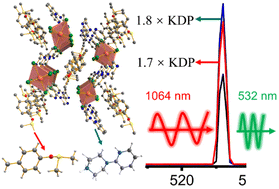
Mixing cations with different chemical properties to induce the generation of asymmetric structures is a new approach for tuning the optical properties of hybrid organic–inorganic metal halides (HOIMHs). In this study, zero-dimensional (C9N3H15)(C9H13SO)MBr6 (M = Bi/Sb, [C9N3H15]2+ = [(C4N2H10)(C5NH5)]2+ and [C9H14SO]+ = [CH3(C6H4)OS(CH3)2]+) are synthesized. Two different cations cause both compounds to crystallize in the polar space group P212121, thus resulting in significant phase matchable second harmonic generation under a 1064 nm laser excitation. Thus, (C9N3H15)(C9H13SO)BiBr6 and (C9N3H15)(C9H13SO)SbBr6 exhibit intensities that are approximately 1.8 and 1.7 times that of KH2PO4, respectively. The results of density functional theory calculations show that both (C9N3H15)(C9H13SO)BiBr6 and (C9N3H15)(C9H13SO)SbBr6 exhibit direct bandgaps of 2.95 and 2.81 eV, respectively. Additionally, because of the distortion of the inorganic octahedra, (C9N3H15)(C9H13SO)SbBr6 exhibited bright yellow emission at room temperature, which is attributed to ns2 fluorescence emission. We believe that the symmetry of the HOIMH crystal structure can be broken by introducing spatially differentiated bifunctional organic cations, which consequently enables even-order nonlinear activities.